Webull is facing renewed scrutiny in the United States after a bipartisan House panel said the brokerage’s structural ties to China pose a national security risk. The report triggered a sharp selloff in BULL shares, putting the company’s ownership, technology infrastructure and handling of U.S. investor data at the center of the debate.
Table of Contents
Webull’s China Structure Comes Under Fresh Congressional Review
The House Select Committee on China said Webull’s ownership architecture, technical workforce, technology infrastructure, cross-border data routing, financing and compliance frameworks are tied to the People’s Republic of China.
The panel said parts of BULL’s technology and operations rely on mainland Chinese infrastructure. It also argued that Chinese laws can require companies to cooperate with government authorities, raising questions about data access and operational independence.
The findings build on concerns lawmakers raised in 2024, when committee leaders asked Webull to explain its relationships with Chinese technology firms Fumi Technology and Hunan Weibu.
BULL’s 2025 SEC filing also disclosed that Hunan Weibu was a mainland China technology-support subsidiary with 863 employees at the end of 2025, equal to 62% of the company’s workforce. The filing separately identifies BULL Corporation as a Cayman Islands company with its principal executive offices in Florida.
Also Read: Coinbase Powers Strong Webull Canada Crypto Deal in 2026
Webull’s U.S. Business Carries Billions in Customer Assets
The issue matters because Webull has a substantial U.S. customer base and financial footprint. The company reported $28.5 billion in customer assets and 28.2 million registered users for the second quarter of 2026, while funded accounts reached 5.13 million. That scale means data-security questions could have consequences beyond the share price.
The committee also focused on BULL’s decision to begin carrying customer cash directly in October 2025, describing the change as creating exposure involving billions of dollars in American capital.
BULL’s latest quarterly filing shows that customer assets rose 79% year over year by June 2026, highlighting the size of the platform under scrutiny. The congressional report does not establish that Chinese authorities accessed U.S. customer data, making the distinction between identified structural exposure and proven misuse important.
Webull Stock Drops as Investors Price in Regulatory Risk
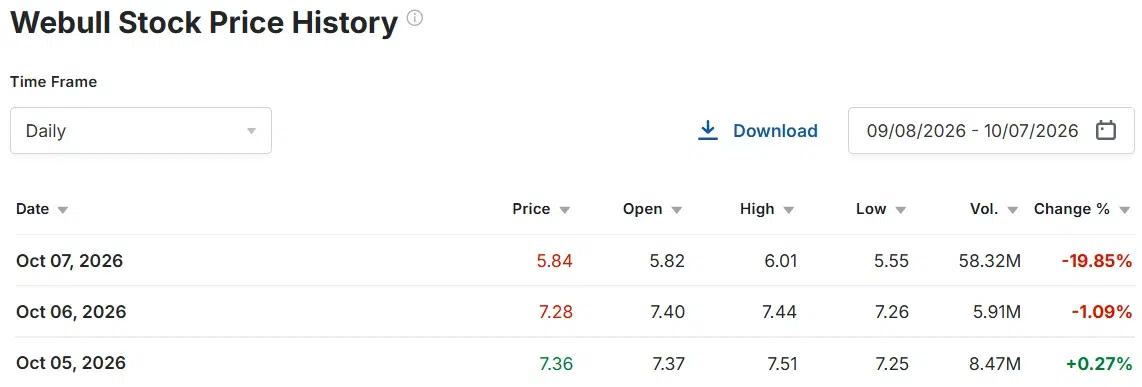
BULL closed October 6 at $7.28, down 1.09%, with about 5.9 million shares traded. Premarket trading on October 7 sent the stock as low as roughly $4.93, a decline of about 32% from the previous close, before the move moderated. The stock had already fallen from a 52-week high of about $14.51, leaving investors to assess whether the move reflects a temporary headline shock or a deeper regulatory discount.
The market reaction also shows why the congressional findings matter even without an immediate enforcement action. A House committee report does not itself impose a fine, trading ban or forced divestment, but it can increase pressure on regulators and lawmakers to examine the company’s U.S. operations. For investors, the next signal is likely to come from BULL’s response and any follow-up from agencies with authority over broker-dealers, data security or foreign-linked financial activity.
Webull’s Next Test Is Data Security and U.S. Market Access
Webull’s own SEC disclosures show that the company has previously identified regulatory scrutiny over its China connections as a business risk. Its 2025 annual report says founder and CEO Anquan Wang is a Chinese citizen and held 79.2% of total voting power as of March 31, 2026. The filing also says Hunan Weibu employed 863 people and was subject to the jurisdiction of the People’s Republic of China.
BULL has rejected the committee’s conclusions, saying the report contains “significant inaccuracies and unsupported conclusions.” The company said its U.S. business operates from St. Petersburg, Florida, and New York City, while U.S. customer data is stored in the United States and access to sensitive data is controlled by the U.S. That response puts data residency and operational controls at the center of the next stage of the dispute.
Also Read: China Crypto Warning Says Blockchain Anonymity Is an Illusion
This article contains market analysis and price predictions. These are not guarantees. Crypto markets are volatile. Always DYOR. Not financial advice.