BlackRock, which oversees $15.5 trillion, reallocated its flagship tokenized Treasury fund on-chain, and now the fund is worth more on Avalanche than it is on the chain it was issued on Ethereum as of April 2024. BlackRock USD Institutional Digital Liquidity Fund (BUIDL), which was issued on Ethereum in March 2024, is now a lot ahead on Avalanche, which turns out to be its third-largest chain after Solana.
The move displays how institutional tokenization is going multi-chain, with Solana taking the lead a switch that speaks to other things, considering BUIDL is at the heart of the real-world asset story.
Table of Contents
The Data Behind the Reallocation
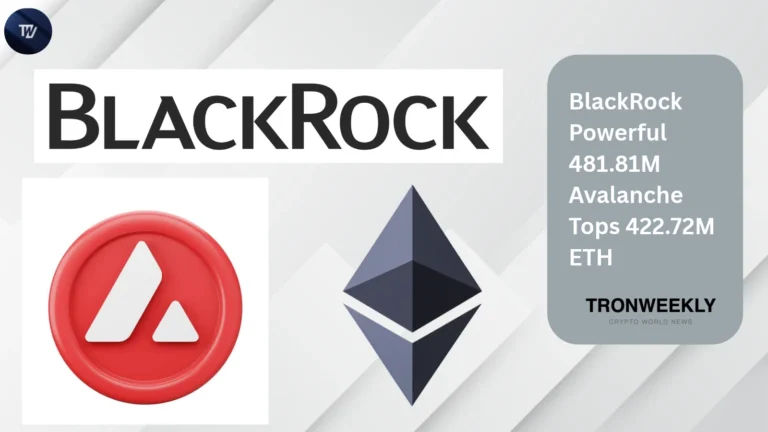
Current stats show Avalanche holding $481.81 million of BlackRock USD Institutional Digital Liquidity Fund versus $422.72 million on Ethereum, with Solana in the lead overall for holdings both ahead of the chain it was issued on (Ethereum). The $2.17 billion fund invests in U.S. Treasury bills, cash, and repurchase agreements, seeking to keep a stable $1 token value while paying daily dividends to eligible holders.

BUIDL operates through Securitize as tokenization agent, with BNY Mellon as administrator and custodian. Flows between chains show reallocation by the administrator, not retail trading. Despite remaining the foundational layer of BUIDL infrastructure, the proportion of supply staked on ETH has diminished versus of other protocols that offer higher speed and lower cost.

Source: Remitly
Also Read: Ondo BlackRock Partnership 2026: Amazing Exclusive Debut
Why Multi-Chain Settlement Is Becoming Institutional Standard
Tokenized Treasuries has become the largest segment of the real-world asset market as institutions hunt for yield bearing cash equivalents on-chain. Issuers are now seeking the optimal settlement speed finality fees, and regulatory compatibility.
Avalanche gives sub-second finality and EVM compatibility on its C-Chain, while Solana has high throughput, low fees, and liquidity depth. Both have built, custody, integrations, and stablecoin adoption into the core infrastructure.
Cross-chain issuance demonstrates that flagship institutions like BlackRock and Securitize can serve customer demand without abandoning their core strategy. Their success signifies a move away from single chain pilots toward production systems where distribution follows demand. It elevates core properties of BlackRock USD Institutional Digital Liquidity Fund from past experiments that have always remained tightly coupled for simplicity.
Also Read: Solana Price Under Selling Pressure as Whale Moves $25.3M in SOL
Implications for Investors, Developers, and Ecosystems
For investors, BlackRock USD Institutional Digital Liquidity Fund yield and risk remain anchored to short term Treasury markets and not AVAX or SOL prices.
This shift does not impact eligibility, fees, or redemption mechanics. For institutions, this sets a clear example that even the largest asset manager will use multiple public chains if necessary for operations. For developers, Avalanche’s larger BUIDL balance expands the scope of integration with lending, collateral markets through sBUIDL.
Source: Binance
For competing ecosystems, the focus will be less on incentives and more on custody, compliance, and liquidity development. And for regulators, multi-chain distribution will introduce new questions surrounding transfer restrictions, investor validation and disclosure of reserves across networks. Exchanges and market commentators should regard chain distribution as an infrastructure indicator, and not a signalling short term trading demand.
Source: LinkedIn
The nature of Avalanche’s sustainability depends on continued inflows and sBUIDL use cases within DeFi, and the extent to which other issuers follow.
Beyond Ethereum’s baseline presence, Avalanche’s share of new issuance will likely expand at a slower pace as other options demonstrate utility. Solana’s dominance will be put to the test as to whether its growth is driven by intrinsic demand or short term allocation.

Source: Binance
Avalanche’s key hurdle will be unlocking the presence of funds into the ecosystem and integrating this into settled activity, including collateralized borrowing. Ultimately, BlackRock USD Institutional Digital Liquidity Funds evolution demonstrates how traditional managers can scale via on-chain instruments across chains and institutional portals and this way form the next phase of institutional tokenisation.
Also Read: Solana Tokenized Stock Volume Surges as SOL Price Eyes $120 Recovery