CFTC relief will give crypto wallets and software providers the ability to link customers to derivative contracts in a regulated environment without registering as introducing brokers if they comply with certain conditions set out by the agency.
Table of Contents
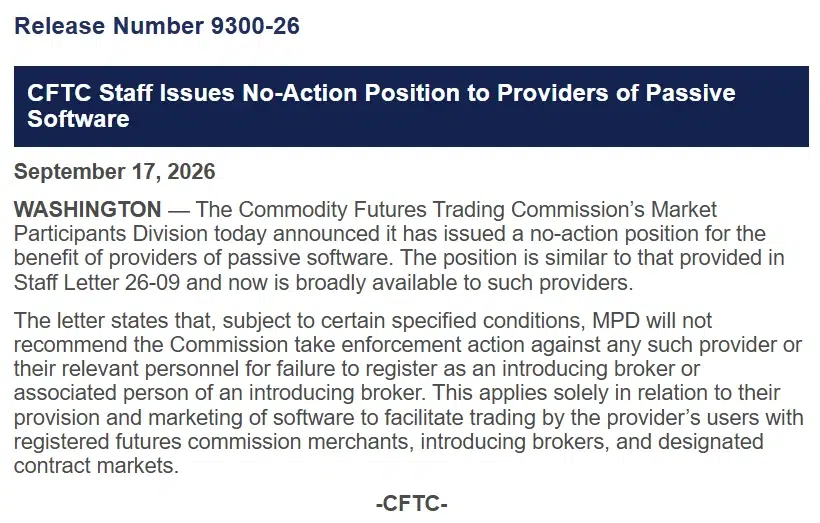
The CFTC Market Participants Division issued a new no-action letter on September 17, 2026, relating to software providers. The new policy extends the relief that was initially given to Phantom Technologies in March and gives the same protection to other software providers.
This initiative is in response to a significant compliance issue facing crypto firms developing portals for users to gain access to regulated futures/derivatives contracts.
According to the new stance, the CFTC will refrain from recommending any form of enforcement action against firms or persons meeting specific criteria from registering as introducing brokers or associated persons.
Also Read | Bitcoin Sentiment Cools as CLARITY and Fed Decisions Hit
CFTC Relief Draws a Line Between Software and Brokerage Services
The stance of the CFTC is based on the distinction between technology that is passive and software that takes part actively in the process of making trading decisions.
The qualified provider will be allowed to provide software that acts as a link between the users and the registered futures commission merchants, introducing brokers and designated contract markets.
But at no time should the provider venture into areas that make the software take part actively in the trading process.
This implies that the technology cannot be allowed to manage customer assets, provide trading instructions or discretionary trades for the users. The March Phantom letter laid the foundation of this basic principle, which was extended in September for qualifying passive software providers.
The requirements also mean that the software providers must link the users to those entities that have been registered with the CFTC. This ensures that the relief is applicable only to the software providing access to the registered markets.
What the CFTC Relief Means for Crypto Wallets
Without the expansion of the CFTC relief provisions, there would be a tough regulatory issue to deal with for a wallet provider that gives access to derivatives under regulation.
Should the wallet enable users to access Bitcoin futures or any other derivatives through its software, the firm may have to decide whether its operation falls into the category of introducing broker services.
Introducing broker licensing comes with some compliance and operational issues that may pose a big hurdle for the software firm.
This new position creates more clarity. A firm can concentrate on developing the technology and bringing its users together with the registered intermediary without having the trading relationship itself regulated.
Phantom Technologies’ March 2026 CFTC position was the beginning. In this letter, the CFTC discussed Phantom’s provision of marketing for self-custodial wallet software that will allow trading with the help of registered futures commission merchants, introducing brokers, and designated contract markets.
In its September decision, the CFTC extends the same type of relief to all eligible passive software providers.
CFTC Relief Comes With Clear Limits
New CFTC Relief is not a blanket exclusion from derivatives regulations.
First, the service provider has to meet all the criteria set out in the Market Participants Division. Legal reviews in the industry highlight some of the areas that fall under these criteria. These include, but are not limited to, disclosure obligations, onboarding directly with registered intermediaries, recordkeeping, advertising, and accepting CFTC Jurisdiction.
Therefore, crypto companies can no longer claim to be software providers.
The difference between passive and active services is still relevant. If a service provider starts to perform functions related to custody, trading advice, or making decisions for its users, these operations might not be covered by the relief.
Also, according to the CFTC, the decision is a no-action position with regard to the Commodity Exchange Act. From a practical perspective, it means that the staff declares not to enforce action against providers who comply with the specified criteria.
CFTC Moves Toward Broader Crypto Market Rules
And this is happening amid steps taken by the CFTC towards creating an extensive regulatory system for digital asset trading.
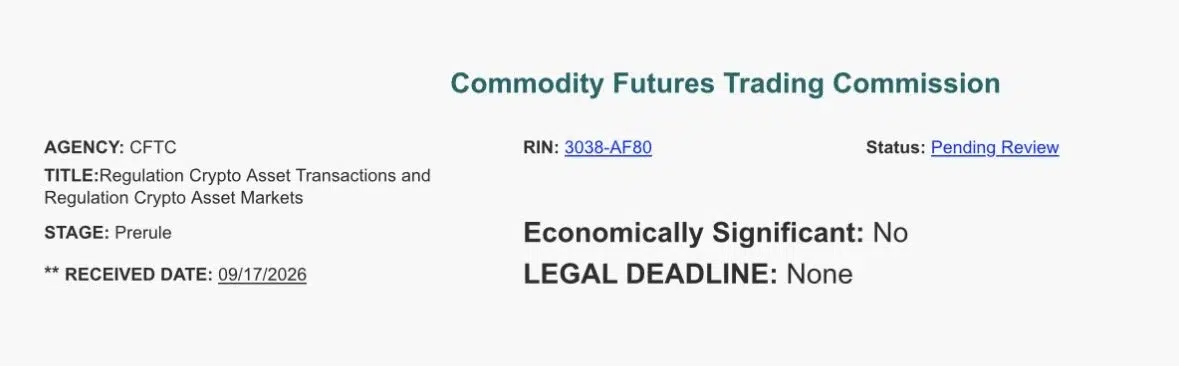
According to a government regulatory database, the “Regulation Crypto Asset Transactions and Regulation Crypto Asset Markets” proposal by the CFTC was put up for interagency review on September 17, and its RIN number is 3038-AF80. It is described as having been “under review” at that time.
The move comes amid the CFTC’s efforts to establish crypto market regulations using its current powers, while the Senate’s CLARITY Act has been stuck in limbo.
The new CFTC Relief offers crypto wallets and software vendors a way to link customers to CFTC-registered derivative businesses if they meet certain conditions.
Also Read | US Sanctions Iranian BitBank Over Alleged Bitcoin Transfers to IRGC