Chainlink partnership with Infosys broadens the blockchain startup’s influence in the institutional finance market as big names in the fintech industry seek to link their legacy banking systems with the on-chain markets.
Table of Contents
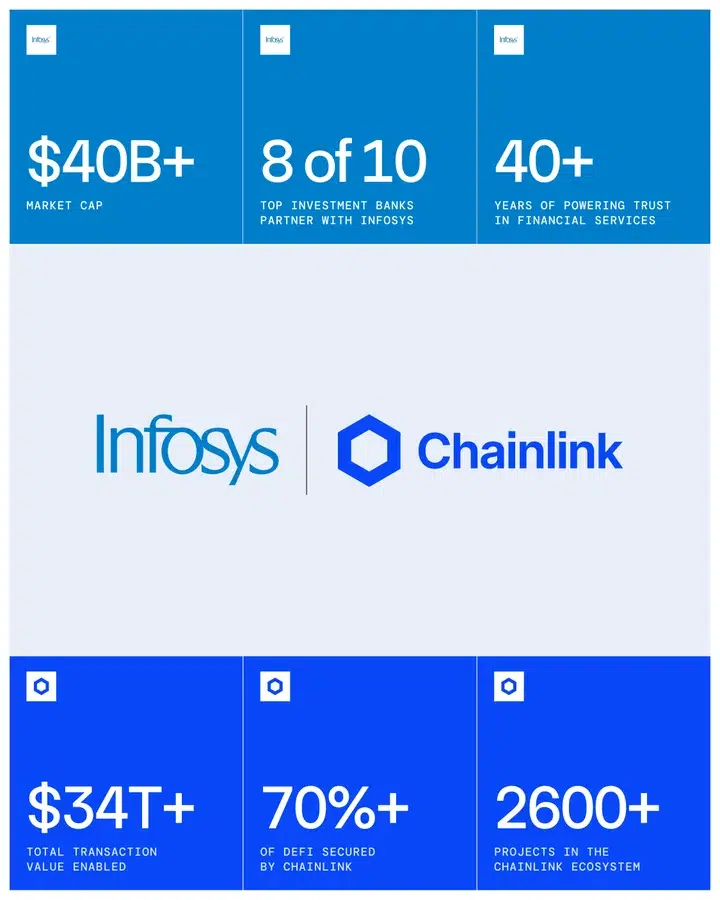
Infosys is an international information technology services firm worth over $40 billion and runs banking and payment systems linked with over 1.7 billion customers worldwide.
The Chainlink partnership revolves around implementing the technology stack of Chainlink within institutional finance. The partnership includes CCIP (Cross-Chain Interoperability Protocol), CRE (Chainlink Runtime Environment), ACE (Automated Compliance Engine), Proof of Reserve, Data Streams, and Data Feeds.
The collaboration focuses not on a single blockchain application but on multiple areas where financial institutions need to deploy blockchain technology. Such areas are interchain interoperability, regulatory compliance, financial data, transaction flow, and reserve verification.
Also Read | Ethereum Price Eyes $3,400 as Bitmine Accumulation Strengthens Outlook
Chainlink Partnership Brings Infosys Into Onchain Finance
The Chainlink partnership creates an additional link between Chainlink and the traditional financial industry via Infosys, which has been dealing with financial institutions for more than four decades.
Infosys’ expertise in the area of financial services has been stressed by Chainlink, and the project says that out of ten of the biggest investment banks in the world, eight have partnerships with Infosys.
But the announcement does not mean that such organizations have already transferred substantial sums of money to blockchain-based systems. On the contrary, the Chainlink partnership involves infrastructure adoption and the development of technology channels that could enable financial organizations to link their existing systems to on-chain markets.
It is essential to highlight the difference between these two aspects because for institutions to adopt blockchain, it is not enough to have access to blockchain. The banks also require market data, compliance, and interoperability.
Chainlink Partnership Expands Institutional Infrastructure
The Chainlink technology stack helps in solving some of these challenges.
CCIP helps systems communicate with each other despite being on different blockchain platforms using an interoperability standard. CRE helps coordinate on-chain-off-chain processes, while Data Feeds and Data Streams offer financial data.
Proof of Reserve helps in the validation of assets used in some financial products, whereas ACE helps solve compliance challenges in digital asset transactions by institutions.
Through the use of these technologies, the Chainlink partnership with Infosys would offer a wider framework of infrastructure rather than having to use different sets of solutions for each of the blockchain and financial applications.
This is especially true because the use of blockchain technology in financial systems has been receiving greater attention in recent years. In fact, for companies that have large banking and payment systems in place, there is no need to have a completely new setup.
Bottomline Adds Another Institutional Link
Infosys is also making its announcement while Chainlink is collaborating with Bottomline – yet another development that highlights linking the existing payment system with the blockchain.
Bottomline, a large SWIFT service provider, has introduced Global Pay Connect, an on-chain payment connectivity solution meant for more than 600 banks. The firm claims that its technology infrastructure processes more than $16 trillion in payments per year.
This solution connects Bottomline’s payment system with the blockchain networks using Chainlink’s CCIP and CRE.
CCIP will offer connectivity between the chains, whereas CRE will ensure the coordination of the payment workflow through both traditional finance and blockchain technology. Thus, financial firms can get access to on-chain payment rails without losing the current payment infrastructure that they work with now.
This approach will decrease the need for banks to establish separate integrations for every blockchain that they would like to access.
Chainlink Partnership Connects Traditional Finance With Blockchain
Both the Infosys and Bottomline partnerships highlight the general trend that Chainlink is following to build bridges between existing financial systems and blockchain technology.
In the partnership with Infosys, Chainlink will address issues such as interoperability, compliance, and data and reserve validation, while the Bottomline platform uses Chainlink infrastructure for payments connectivity.
Collectively, both developments show that the way to blockchain adoption in traditional finance is through current financial technology companies instead of institutions building their systems from scratch.
In any case, neither development proves that traditional finance has migrated to blockchains yet. The future implications of these developments will depend on how the institutions use these technologies and regulations.
Nevertheless, the Infosys Chainlink partnership is yet another move toward making blockchain infrastructure available to big financial players, and integration with Bottomline will allow R3 to apply the same strategy for global payments connectivity.
Also Read | SoFi Launches Stablecoin Settlement for $25B Mastercard Card Program