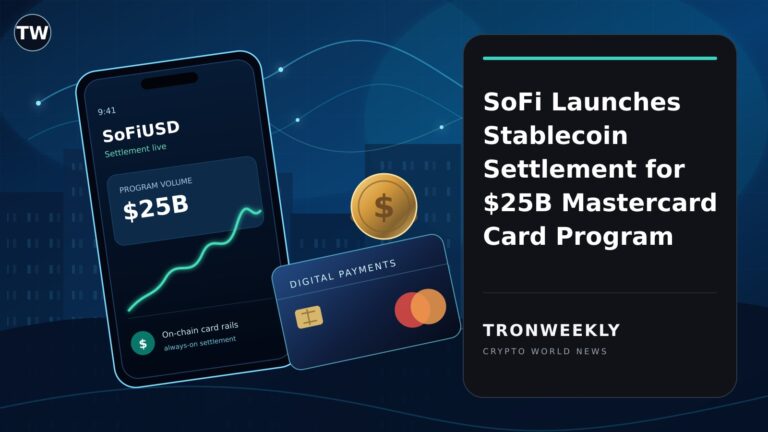
SoFi Technologies has moved its $25 billion card program onto blockchain rails through SoFiUSD. The bank-issued token now handles stablecoin settlement for SoFi debit and credit transactions on Mastercard’s global network six months after the companies announced their partnership.
Table of Contents
SoFi Bank is migrating its full card program to on-chain processing. The program is expected to handle more than $25 billion in annualized volume. That figure is an annualized estimate for the program, rather than the completed transaction value.
Transactions are already live on the blockchain. SoFi said SoFiUSD is the first stablecoin issued by a nationally chartered bank for settlement across Mastercard’s network.
What Does Stablecoin Settlement Change for Merchants?
It ensures that stablecoin settlement is separate from most merchant activities. Merchants have no need to possess SoFiUSD, set up wallets for the blockchain, or any other additional infrastructure as per SoFi.
Also Read: GenLayer CEO Says CLARITY Act Stall May Bring Back Crypto Middlemen
Using SoFi’s Big Business Banking system, the settlement money is sent to the SoFi Bank account, after which merchants can withdraw money at all times without any fees associated with withdrawals.
According to SoFi CEO Anthony Noto, these two companies took only six months to take this product from an idea to reality. As per Sherri Haymond, an executive at Mastercard, the product launch went beyond testing into production with network security intact.
How SoFiUSD Fits Into SoFi’s Banking System
The SoFi Bank, N.A. token known as SoFiUSD is issued by the Office of the Comptroller of the Currency. According to SoFi, SoFiUSD is redeemable 1-to-1 with the U.S. dollar and is backed primarily by cash.
Institutions and SoFi members can use SoFiUSD for payments and settlement purposes. SoFi also indicates that SoFiUSD is not a bank deposit, nor is it covered by FDIC or SIPC insurance.
Access by consumers preceded the launch of the card product. In May, SoFi launched SoFiUSD via the SoFi app. Nearly 15 million members now have the capability to purchase, sell, hold, and convert SoFiUSD. It uses Ethereum and Solana blockchain technologies.
Prior to the card launch, SoFi’s agreement with Mastercard in March had highlighted card settlement as one use case for institutional customers. It had also indicated the Galileo platform technology offered by SoFi as a channel for banks and card issuers to use stablecoin settlement via SoFiUSD.
Why Mastercard Is Expanding On-Chain Payments
The new release comes after the announcement made by Mastercard in June regarding its stablecoin settlement strategy. Some of the regulated tokens include USDC, PayPal USD, Global Dollar, Pax Dollar, Ripple USD, and SoFiUSD.

Some of the supported blockchains included Ethereum, Solana, Polygon, Base, Arbitrum, Canton, Tempo, and XRP Ledger. The strategy also included intraday, weekend, and holiday processing.
These options allow issuers and acquirers to have full control over time and liquidity without any changes to current Mastercard payment processes. According to Mastercard, the options work alongside existing security protocols, fraud prevention, and dispute resolution services.
The acquisition of BVNK by Mastercard was completed on August 3. It has been announced at the cost of up to $1.8 billion.
Where SoFi Plans to Take SoFiUSD
The release is not limited to transactions involving SoFi’s own bank. SoFi is negotiating with some of the biggest U.S. merchants about the stablecoin settlement process. These include multinational merchants and technological services providers.
Cross-border payments and remittances are considered too. SoFi and Mastercard are looking at other opportunities to use SoFiUSD for money movements across the card network when expanding production infrastructure.
SoFi is increasing distribution through its September partnership with Payward. Kraken is going to include SoFiUSD in its assets listing, while Payward will join SoFi’s real-time settlement network that enables round-the-clock transfers of U.S. dollars.
The selection of Kraken Prime also supports SoFiUSD distribution. It aims to increase the digital asset’s liquidity among institutions outside SoFi’s platform.
The rollout across the card network provides a live environment for testing the stablecoin settlement process. The next stage of implementation depends on merchant integration and network development. It also requires making blockchain processing useful for businesses without requiring them to manage crypto infrastructure.
Also Read: Infosys and Chainlink Connect 1.7B Accounts to Onchain Finance