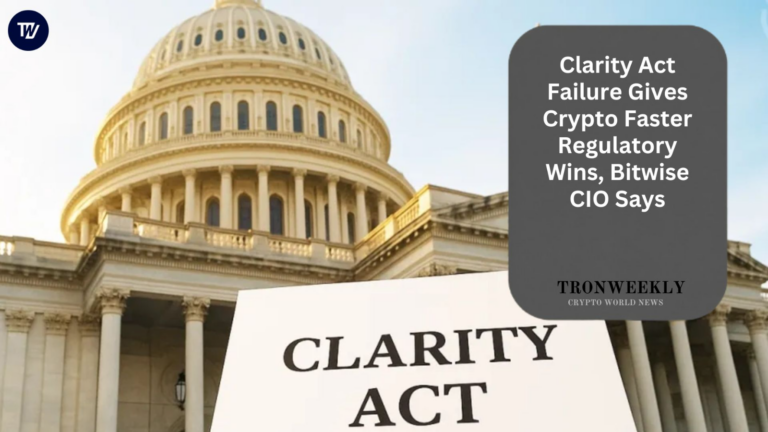
Bitwise Chief Investment Officer Matt Hougan says the failure of the CLARITY Act created an unexpected outcome for crypto markets. While the bill would have offered longer-term federal certainty, its collapse also avoided restrictions on stablecoin rewards and some exchange activities, while regulators moved ahead with separate measures.
Table of Contents
The Senate rejected the procedural motion to advance the CLARITY Act on September 15, with 49 senators voting for it and 50 against. Bitcoin has since gained nearly 11%, while Ether has risen roughly 12%. Total crypto market capitalization also increased from about $2.65 trillion to $2.95 trillion.
Also Read | Coinbase Builds Financial Accounts for AI Agents and Bots
Crypto Market Rallies After CLARITY Act Setback
The market reaction differed from expectations that the legislative setback would weigh on digital assets. Hougan had previously warned that failure to advance the bill could create several weeks of difficult market conditions. By September 17, he had revised that view as Bitcoin moved above $80,000 despite declining prospects for the legislation.
Hougan’s latest analysis focuses on what the crypto industry avoided when negotiations around the bill ended without passage. He argues that some proposed compromises could have limited stablecoin rewards and changed the competitive position of established exchanges. The result, in his view, was less legislative certainty but faster action through regulatory agencies.
Stablecoin Rewards Avoid CLARITY Act Restrictions
Stablecoin rewards are central to Hougan’s argument. Under the amended bill, payments of interest or yield to customers holding stablecoin balances would be forbidden. Now that the bill is deadlocked, the exchange will be able to keep running within the current regulatory scheme, along with the provisions of the GENIUS Act applicable to stablecoins and rewards.
This matter relates to both exchanges and their clients since rewards may be an element of the strategy for attracting and keeping customers. Moreover, according to Hougan, the existing exchanges have been protected from extra competition since there was another way to obtain a federal license to operate.
SEC Moves Ahead With Tokenized Stocks
The regulatory move was made soon after the Senate vote. On September 17, the SEC enacted an Innovation Exemption which enabled the trading of some tokenized US stocks by the Tokenized Securities Venues through on-chain permissioned markets. Some liquidity providers qualify within the scope of this exemption, provided that certain conditions are met.
The SEC said the measure is intended as an interim step while it considers longer-term rules for onchain markets. The Innovation Exemption will run for five years, with some constraints on the type of securities eligible, volume of trading, participation of participants, and investor protection.
Token Buybacks Gain Regulatory Guidance
Additional guidance from the SEC was issued on September 25 regarding crypto, related to token buyback, network growth, and marketing claims. The SEC staff indicated that an announcement regarding the buyback of a non-security crypto asset that operates on a functional network will not be considered a promise to make managerial effort as per the securities law.
This guidance does not provide an absolute exemption for all tokens or all buyback schemes. According to the SEC, the analysis may take into consideration facts such as the functionality of the network and the presentation of the buyback scheme as a means of earning returns. This further adds to the regulatory developments despite the failure of the CLARITY Act.
CFTC Also Advances Crypto Rules
However, the Securities and Exchange Commission is not the only body that has taken steps forward. The Commodity Futures Trading Commission has continued working on crypto-specific regulations and guidelines despite the ongoing legislative stalemate in Congress. Recently, the CFTC has acted regarding tokenized assets and blockchain networks used to keep required records of regulated companies.
This activity of the regulatory bodies is crucial to understanding Hougan’s reasoning. While the CLARITY Act is supposed to provide a wider regulatory framework for cryptocurrencies, it is still possible to resolve certain matters without any legislative changes, relying solely on the powers of particular regulators.
CLARITY Act Failure Leaves Regulatory Gaps
Hougan’s analysis also identifies a major limitation. Regulatory guidance, exemptions and agency actions can be modified by future regulators, while congressional legislation generally provides a more durable legal framework. The SEC itself described its Innovation Exemption as temporary and said additional rulemaking would be needed for a lasting approach.
For crypto businesses, the distinction matters across several areas, including stablecoins, exchanges, tokenized securities and token economics. Companies can respond to current agency rules, but future changes could alter the conditions under which they operate. Investors and market participants therefore face a regulatory environment that remains active but not fully settled.
The SEC has also opened up for public input on its Innovation Exemption to enable market players to provide suggestions prior to any potential regulatory change in the longer run. According to the SEC, the regulator will observe how the tokenized markets will develop and take advantage of this experience for future rulemaking.
The immediate takeaway is that the CLARITY Act’s failure did not stop U.S. crypto regulation from advancing. Rather, other agency-level measures have been taken in relation to tokenized stocks, token buybacks, and other issues relating to digital assets. This is what Hougan thinks is another important aspect behind the market reaction, but one which comes with reduced statutory certainty.
Regarding the crypto industry, it is up to Congress to decide what to do in terms of reintroducing comprehensive market structure legislation and how regulators will implement their interim regulations in the meantime.
Also Read | Devcon Mumbai Nov 3-6: Powerful Amazing Ethereum Revival