
CleanSpark Bitcoin production rose to 593 BTC in August even as average hash rate declined. The miner sold 821 BTC during the month. Those sales pushed treasury holdings down by 228 BTC despite higher monthly output.
Table of Contents
The August result marked only a modest production gain, but the balance-sheet movement was larger. According to the report, CleanSpark mined seven more BTC than July’s 586 BTC while selling 242 more coins than the previous month. Its holdings consequently fell to 13,703 BTC from 13,931 BTC.
Also Read: Strategy Deploys $176M on STRC Buyback After Pausing Bitcoin Accumulation
How Did CleanSpark Bitcoin Production Rise Despite Lower Hashrate?
That contrast gives the monthly update a broader angle than production alone. CleanSpark increased output while its average operating hashrate slipped to 38.3 EH/s from 38.6 EH/s in July. The company’s reported operational hashrate remained unchanged at 50 EH/s.
CleanSpark Bitcoin production also rose while the deployed fleet became smaller. The company listed 201,269 machines at August 31, compared with 230,507 at July 31. That was a reduction of 29,238 deployed miners between the two monthly reports.
Peak fleet efficiency stayed at 16.07 joules per terahash in both months. Average daily production increased to 19.12 BTC from 18.91 BTC in July. Peak single-day output, however, eased to 20.40 BTC from 20.77 BTC.
The company defines operational hash rate as the highest computing power reached concurrently by installed and functional miners.
Those machines must be configured, supported by energized infrastructure, and capable of contributing to a mining pool or the Bitcoin network. The figure is not CleanSpark’s monthly average hashrate.
Why Did CleanSpark’s Bitcoin Treasury Fall in August?
CleanSpark Bitcoin production reached 4,903 BTC for the calendar year 2026 through August. The miner opened the month with 13,931 BTC but mined 593 BTC. However, total sales of 821 BTC more than covered the mined amount.
These sales were made via three distinct sources. CleanSpark made spot sales of 77 BTC, exercised calls worth 500 BTC, and executed a delta-neutral basis trade worth 244 BTC. In these transactions, its average price was $65,420 per BTC.
CleanSpark uses an average that involves net sale proceeds and net premiums, both of which are divided by total Bitcoin sold. This means that the measure covers beyond just the spot sale proceeds. In July, the corresponding measure was $66,133, where CleanSpark sold 579 BTC via spot sales and call exercises.
Also, there was a change in the treasury position. CleanSpark reported that 3,951 BTC were used as collateral or receivables in derivative transactions. July’s corresponding number was 4,070 BTC, while the total holding was seven BTC more than in June.
What Improved Bitcoin Mining Economics During August?
Industry conditions improved late in August, adding context to CleanSpark Bitcoin production. Luxor’s Hashrate Index analysis shows that the monthly hash price averaged $34.63 per petahash per day, up from $31.21 in July. The August average was the highest recorded since May.
Hashprice opened in August at $31.63 per petahash per day and closed at $39.33, according to Luxor. That represented a 24.4% increase from the opening level. The August 27 reading briefly moved above $40 for the first time since January 19.
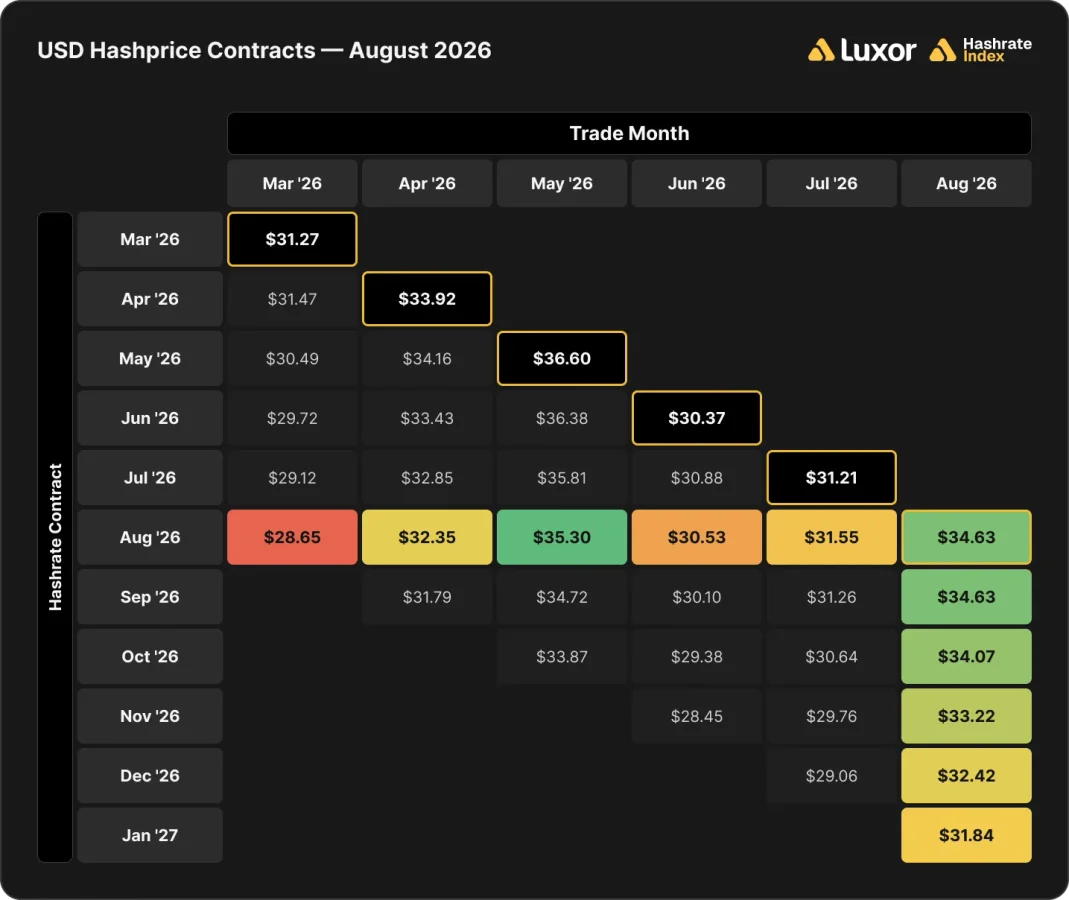
Bitcoin itself opened the month at $62,889 and closed at $78,312 in Luxor’s monthly data. The 24.5% increase helped lift dollar-denominated mining revenue late in the month. Luxor said August 20 through August 31 averaged $38.95 in daily hashprice.
The stronger late-month environment followed a difficult fiscal quarter for the miner. CleanSpark reported $138 million in revenue for the three months ended June 30, down 30.5% from $198.6 million a year earlier. The company reported a $239.8 million net loss for that quarter.
Its Securities and Exchange Commission filing reveals more details about mining costs in August. The direct energy cost per coin to mine at owned facilities in the June quarter was $44,406. Average revenue per each Bitcoin mined in the same period was $71,692.
Depreciation cost per each mined coin at owned facilities for the June quarter was estimated to be $51,871. Depreciation cost together with financing cost made the total direct cost per coin be $96,277.
These results of the June quarter demonstrate accounting consequences that can differ from those of the mining process. CleanSpark reported a fair-value loss of Bitcoin in the June quarter at $116.3 million, while there was a fair-value gain in the corresponding 2025 quarter.
Revenue decreased yearly, however, in a separate filing, the company showed that direct energy cost per mined coin was a bit less than the $44,806 that was reported in the same quarter of 2025 despite the fact that average revenue per Bitcoin mined was smaller in 2026.
Where Is CleanSpark Expanding Beyond Bitcoin Mining?
Consequently, the bitcoin production of CleanSpark falls under a corporation making a transition into building huge data centers.
During July, the company made an announcement about signing a 20-year infrastructure lease deal at its campus based in Sandersville, Georgia. According to CleanSpark, the revenue from the contract in the first period amounted to $6.6 billion.
The deal at Sandersville provides the corporation with 175 megawatts of critical IT loads, whose deliveries are supposed to take place in the last quarter of 2027.
Construction activities proceeded at the site in August, according to CleanSpark. It is a component of the company’s plans to monetize its power and data center capabilities beyond Bitcoin mining.
Development of Texas power was one of the issues discussed in the release of August. According to CleanSpark, ERCOT granted it conditional batch-zero classification for 585 MW of contracted baseload capacity and 300 MW of studied load capacity.
What Should Investors Watch in CleanSpark’s Next Update?
The firm recorded 1.8 gigawatts of contracted power capacity and 808 megawatts of maximum concurrent power consumption in August.
The numbers did not vary from July. This means that CleanSpark Bitcoin production increased despite the lack of an increase in either hash rate or power consumed.
The numbers recorded in August indicate a miner whose Bitcoin production has gone up using fewer miners and a lower average hash rate.
The firm has seen its sales exceed its production levels and reduce its treasury reserves. The CleanSpark Bitcoin production is just part of its evolving capital plan.
Also Read: Circle’s Major $400M Tazapay Deal Powers $25B USDC Growth