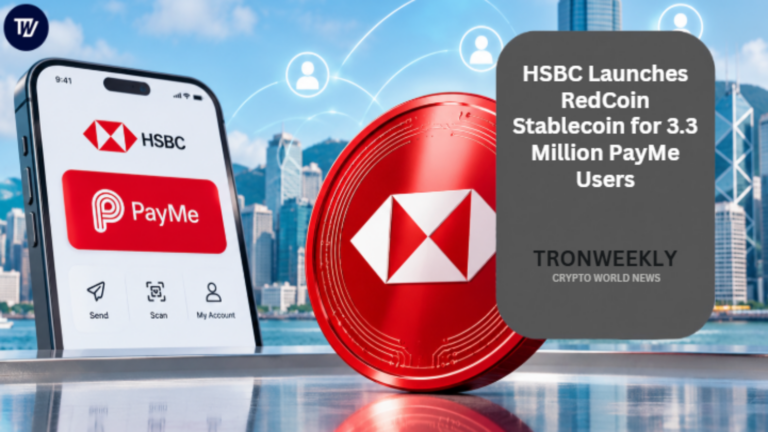
HSBC RedCoin Stablecoin is launching in stages from October 23, 2026, for more than 3.3 million users of Hong Kong’s PayMe payment app. The Hong Kong dollar-backed digital currency initially supports person-to-person transfers and payments to merchants, extending HSBC’s digital asset services into everyday retail transactions.
Table of Contents
The rollout allows PayMe users to activate RedCoin wallets without opening additional accounts or maintaining minimum balances. According to a recent Post, customers can update their app, select the wallet and make instant transfers through an interface similar to the existing PayMe experience. HSBC expects access to expand before the weekend.
Also Read | Visa in Talks to Buy Fireblocks for $2.5 Billion
HSBC RedCoin Stablecoin Adds Retail Payments
HSBC will be rolling out RedCoin through PayMe before allowing more customers to use the stablecoin within the bank’s mobile banking app in Hong Kong. According to Lawrence Li, head of PayMe, phase one will focus on providing reliable services to customers and instilling trust in the digital currency. The bank carried out an internal test with close to 100 employees.
HSBC has not revealed its RedCoin stablecoin circulation target. However, the bank anticipates its use by retail customers once they are able to use the stablecoin via an application they are currently using. In addition, further incentives will be provided to encourage people to spend their RedCoin on selected merchants and dining outlets.
Settlements will be made in accordance with the same schedules as those for regular Hong Kong dollar transactions. This enables merchants to start accepting RedCoin payments without making any extra investments into their settlement procedures. Settlement times will be improved through future updates, although the stablecoin wallet will observe the same transaction limits as the normal Hong Kong dollar wallet.
Tokenized Investments Expand RedCoin’s Role
HSBC aims to launch RedCoin into its Hong Kong mobile banking app by the end of 2026. This integration is likely to provide customers the ability to subscribe to tokenized money market funds with investments as low as HK$100, broadening the scope of the planned application of the stablecoin beyond payments into digital investment products.
According to John O’Neill, managing director of digital assets and currencies for HSBC, subscription to tokenized funds via the stablecoin allows customers to settle the transactions instantaneously rather than wait for days. In addition to the above, HSBC plans to launch tokenized gold and third-party funds, and explore wholesale uses through partnerships.
Tokenization converts financial assets into digital tokens via blockchain-based networks. It provides an approach to handling ownership and transactions of investment products. Through its bank’s infrastructure, the services provided by HSBC link a payment solution to investment solutions, although the product offering, eligibility criteria, and risk factors remain pertinent to the customer.
HSBC Builds on Its Digital Investment Strategy
HSBC’s October 15 launch of Portfolio+ provides additional context for its expanding digital investment services. Portfolio+ allows eligible retail customers in Hong Kong access to professionally managed portfolios that consist of exchange-traded funds, automatically rebalanced to ensure investment consistency with chosen strategies and risk profiles.
The strategies offered by Portfolio+ include Growth, Enhanced Income and Sustainable, with an initial investment of HK$10,000 and an incremental investment of HK$ 1,000. The lower entry price of HK$100 by RedCoin into tokenized money market funds is significant, despite differences between the two types of products in both purpose and investment requirements.
Both examples illustrate how HSBC is working toward digital access to both professionally managed portfolios and tokenized financial instruments. Portfolio+ uses professional portfolio management, whereas the RedCoin stablecoin investment strategy revolves around subscribing to tokenized funds through a stablecoin. Neither of the two announcements suggests that all investment products are immediately accessible.
RedCoin Stablecoin Expands HSBC’s Digital Asset Strategy
The regulation of stablecoins came into force in Hong Kong from 1st August 2025, and the Hong Kong Monetary Authority has issued licenses to HSBC Bank and Anchorpoint, a joint venture between Standard Chartered, Animoca Brands and HKT, from April 2026.
HSBC has supported $8.3 billion in digitally native bond issuance globally, while its tokenized gold product in Hong Kong has recorded $2.5 billion in cumulative trading value. These figures highlight the bank’s existing digital asset activity as it expands into stablecoin payments and tokenized investments.
In addition to testing the acceptance of RedCoin stablecoin as a means of regular payments, its launch will show how users accept and appreciate the coin’s investment capabilities. Further steps include the availability of the PayMe app and mobile banking services and additional tokenized products until the end of the year.
Also Read | Avalanche Price Sees Bullish Momentum as 62% of Banks Anticipate Blockchain Adoption