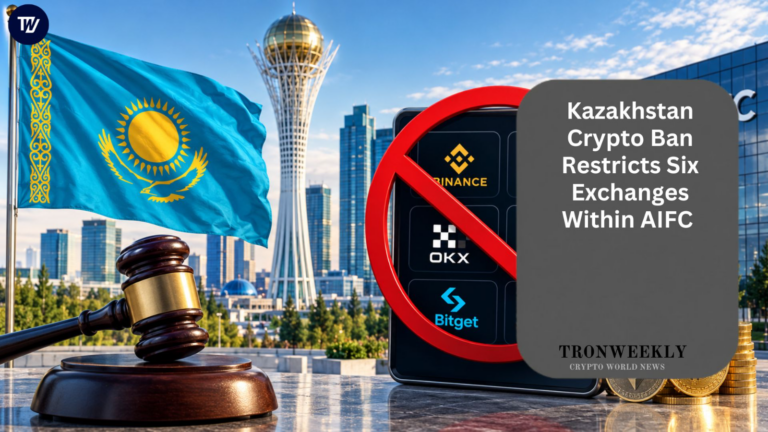
The Kazakhstan crypto ban has intensified regulatory action against unlicensed digital asset platforms after a court restricted Coinbase and five other exchanges from offering services within the Astana International Financial Centre (AIFC). The ruling covers BingX, Bitcoin.com, Huobi Global (HTX), BitMart, Coinbase and WEEX, according to the financial regulator.
Table of Contents
The Astana Financial Services Authority (AFSA) announced the injunctions following legal proceedings against platforms operating without the required authorization. The court prohibited the companies from providing, advertising or offering digital asset services and distributing related mobile applications within the financial centre. However, the ruling does not establish a nationwide ban across Kazakhstan crypto ban.
Also Read | BNB Price Eyes $770 Recovery After NBA Alerts Launch
Kazakhstan Crypto Ban Applies Only Within AIFC
The court of the AIFC delivered its decision on September 15, 2026, regarding seven of the platforms originally involved in the case. LBank was removed from the court order by September 18 because the platform had banned access to its services in Kazakhstan. The other six exchanges remain subject to the injunctions.
The AIFC is active in Astana but operates under a different legal regime and a separate regulatory body. Any cryptocurrency company must be authorized to provide services in the financial centre for the injunction. Sir Stephen Richards noted that the restriction applies to the financial centre and its residents, not necessarily to the whole of Kazakhstan crypto ban.
As for Google and Apple, which operate application stores, their inclusion in the court case involves the issue of geographic restrictions on access to the platforms in question. Nevertheless, the court did not deliver injunctions for those companies but suggested that AFSA discuss the matter with them first.
AFSA Expands Enforcement Against Unlicensed Platforms
AFSA initiated an enforcement operation against unlicensed cryptocurrency platforms in 2025, after it issued notifications to over 20 platforms. The notifications outlined the AIFC’s licensing requirements, as well as the prohibitions on advertising and conducting digital asset activities without being licensed. Legal action was taken in 2026 against those platforms that refused to comply with the regulations.
According to the chief executive of AFSA, Evgeniya Bogdanova, nine cryptocurrency platforms decided to block access to their apps via Google Play and Apple’s App Store in Kazakhstan. In light of the decision, the regulator decided to withdraw from its claims against the firms in question. There were seven other platforms that showed interest in getting permission to trade in digital assets. However, there is no information on whether AFSA approved such requests.
In addition, the regulator has cooperated with Kazakhstan’s National Bank since May 2026 in tackling issues of unauthorized activities in the field of digital assets. The newly issued injunctions are the next step of AFSA’s enforcement actions against violators, while the decisions in the case of other platforms can help understand how the process goes.
Unlicensed Crypto Services Raise User Protection Risks
Importantly, the ban is important because these unlicensed companies operate beyond the AIFC’s regulatory authority. AFSA has indicated that clients of such unlicensed platforms are not afforded the same protection as the clients of licensed companies, which include asset protection, disclosure of information, and complaints resolution processes. One should be certain that the company is authorized.
Another issue raised by the court was the difference between licensed and unlicensed businesses. Firms that are licensed pay fees to meet certain regulatory requirements, including anti-money laundering and counter-financing of terrorism, among other requirements. Firms that are not licensed do not have to fulfill these requirements and this creates an unfair advantage over licensed firms.
Kazakhstan Crypto Ban Expands Amid Unlicensed Exchange Crackdown
Indeed, Kazakhstan has implemented further measures concerning illegal cryptocurrency service providers in recent times. In November 2023, the authorities blocked the website of Coinbase for violating the nation’s laws regarding the digital assets regulation. Furthermore, in January 2026, news appeared that more than 1,100 unlicensed cryptocurrency exchange sites were blocked in Kazakhstan crypto ban during the previous year.
The recent decision does not prove that the listed six cryptocurrency exchanges have been already restricted from operation across the whole country. The court gives AFSA the ground to apply restrictions in the framework of AIFC, including geolocation-related restrictions using the mobile application. Further actions will include the cooperation with Google and Apple as well as monitoring of the platform functioning without any authorization.
Users can consult AFSA’s official Public Register to check which companies hold licenses and which digital asset services they are permitted to provide. For exchanges, the case highlights the importance of securing the appropriate authorization before serving customers within the AIFC. The broader takeaway is that Kazakhstan crypto ban oversight involves distinct national and AIFC rules, and the geographic scope of each restriction matters.
Also Read | SharpLink Strong $400M ETH Yield Hits 27,945 ETH Growth