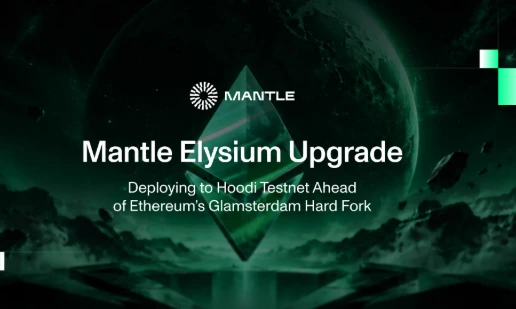
Mantle has announced that its Glamsterdam-compatible upgrade Elysium will deploy to the Hoodi testnet on October 26, after Sepolia activated Glamsterdam on October 6. The move gives developers an early environment to test Ethereum’s next major upgrade, including parallel execution and faster block processing, before it reaches mainnet.
The deployment positions Mantle as one of the first Layer-2 networks to align closely with Ethereum’s upgrade timeline. With the gas limit scheduled to rise to 200 million on Hoodi, builders can stress-test performance and compatibility under mainnet-like conditions.
Table of Contents
What Elysium Tests on Hoodi
Elysium mirrors three core components of Glamsterdam. The first is enshrined proposer-builder separation, defined in EIP-7732, which formalizes the role of block builders within the protocol. The second is block-level access lists for parallel validation under EIP-7928, which allows transactions with no dependencies to be processed in parallel. Third is re-architected gas accounting for state creation and access, which boosts speed and granularity of pricing.

Source: Medium
By putting on Hoodi, Mantle offers a public proving ground. Applications wallets bridges, and infrastructure developers can see how contracts perform with the updated gas rules and whether parallel execution causes clashes.

Source: Remitly
Ethereum’s Hoodi announcement says the testnet is crucial to smother bugs before mainnet. The 200 million gas limit increase is substantial. Increased limits mean more transactions per block but also a need for more-hardware-hungry validators and at a minimum, faster state growth. With Hoodi researchers can monitor these interactions in a sandbox.
Also Read: Mantle Leads RWA Yield in 2026 With $201M Productive TVL
Why Does it Matter that Mantle is Leaning in First
Mantle is an L2 scaling solution backed by ethereum, and to be credible, it must scale while remaining compatible. The countdown to early support is a step in the direction to signal technical direction and minimize fragmentation should layers behind be slow to implement for a longer period.
For builders, early access allows time for their gas estimation and mempool behavior to adapt to the Ethereum upgrade. For institutions considering L2s for tokenized assets and stablecoin settlement, a predictable upgrade path reduces operational risk.
For investors and speculators, the development signals engineering progress. For Ethereum clients and researcher teams, early versions of a major implementation can be valuable feedback. Builders have lower costs to migrate when Glamsterdam goes mainnet; users will enjoy better throughput and more predictable fees.
The full story is Ethereum scaling via L1s and L2s, and Glamsterdam is the continuation of years of improvements toward efficiency and state management. If parallel execution passes, it could help close the gap with throughput-focused competitors and make Ethereum a network of choice for settlement.
Also Read: Mantle Migrates Super Portal to Chainlink CCIP to Strengthen Cross-Chain Security
Open Runs, Obstacle Course
Hoodi on October 26 will be focused on plans to bring parallel execution to mainnet for Ethereum and Mantle. On top of that, we will assess client diversity, validator readiness, and exchange support to evaluate the path of transition. Experience from past upgrades suggest that even thoroughly planned changes can fail to account for tooling gaps.
For exchanges, wallets, and indexers, the upgrade necessitates additional software work to support new access list formats and gas calculations. For regulators, stable progress without distraction ensures that Ethereum continues to grow up as a mature network.
Though we distinguish compatibility from constraint in our decision to pursue it, it is a feature that must be designed for. Based on testnet success, the early experiment on Mantle could act as a bellwether for the efficiency of parallel execution across variety of applications, workloads, and addresses in the months ahead.
Also Read: Mantle Proposes 30,000 ETH Loan to Support Aave After Exploit Losses