
The New Zealand-India trade deal has been successful in overcoming its biggest domestic obstacle after the New Zealand Parliament passed legislation for the implementation of the FTA between India and New Zealand. The legislation passed by 93 to 29 votes, with even the opposition Labour Party backing the bill.
Table of Contents
Under the agreement, it is estimated that the tariffs will be eliminated or reduced substantially on roughly 95% of New Zealand’s exports to India upon the implementation of the agreement. As per an official quoted by the Press Trust of India, the pact may come into effect on October 19.
Also Read | Polymarket Faces $10 Million Fraud Attempt as CEO Response Draws Scrutiny
New Zealand India Trade Deal Expands Market Access
The New Zealand-India trade deal is an agreement aimed at providing greater market access while lowering barriers to trade between the two nations. Over half of the items listed in the accord will be exempt from any duties from the moment the agreement becomes effective.
According to Reuters, New Zealand Trade Minister Todd McClay stated that the advantages for exporters would be “immediate and significant.” The agreement is expected to open up more opportunities for export-oriented businesses from New Zealand.
According to the deal, tariffs on 95% of New Zealand exports to India would be phased out or slashed eventually. In addition, according to the government of New Zealand, 57% of its exports to India would be duty-free from the outset.
In the case of India, the deal gives Indian exporting companies duty-free access to New Zealand for goods exported by them. Some of the sectors benefiting from this trade deal would be textiles, apparel, pharmaceuticals, engineering goods, agriculture, and processed foods.
$20 Billion Investment Commitment Adds Bigger Economic Angle
The New Zealand India trade deal is not only about cutting down tariffs but also includes a pledge from New Zealand to invest $20 billion in India within the next 15 years.
This aspect brings a long-term dimension to the agreement and may open the door for investors in different industries like manufacturing, infrastructure, agriculture, technology, and other sectors.
The investment program also adds more value to the agreement beyond traditional trade in goods. With reduced tariffs and improved access to markets, businesses from both countries have more chances of expanding their businesses and creating business connections.
India and New Zealand Look to Expand Bilateral Trade
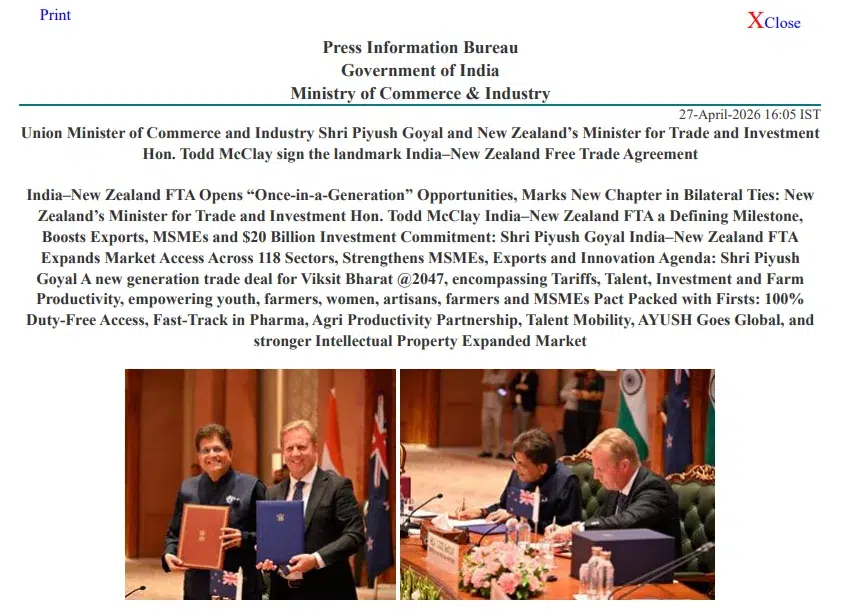
The agreement was signed by India and New Zealand on April 27, with the negotiations primarily revolving around strengthening trade relations between the two nations.
The bilateral trade volume between the two nations stood at NZ$3.99 billion ($2.29 billion) in the year up to June 2026. Currently, India stands as the ninth-largest export market of goods and services for New Zealand.
Before Indian Prime Minister Narendra Modi visited New Zealand in July, New Zealand Prime Minister Christopher Luxon had mentioned the advantages that New Zealand will derive from this deal. 57% of New Zealand’s exports to India will have zero tariffs under the new agreement.
This move has been seen as yet another key step towards the implementation of the New Zealand India trade deal. With the agreement coming into effect, both nations will benefit from reduced tariffs and more business prospects.
Thus, the New Zealand India trade deal has been viewed as one that involves not only the reduction of tariffs but also a commitment to investment over the long term.
Also Read | MORPHO Price Targets $5.46 as Base DeFi Activity Expands Further