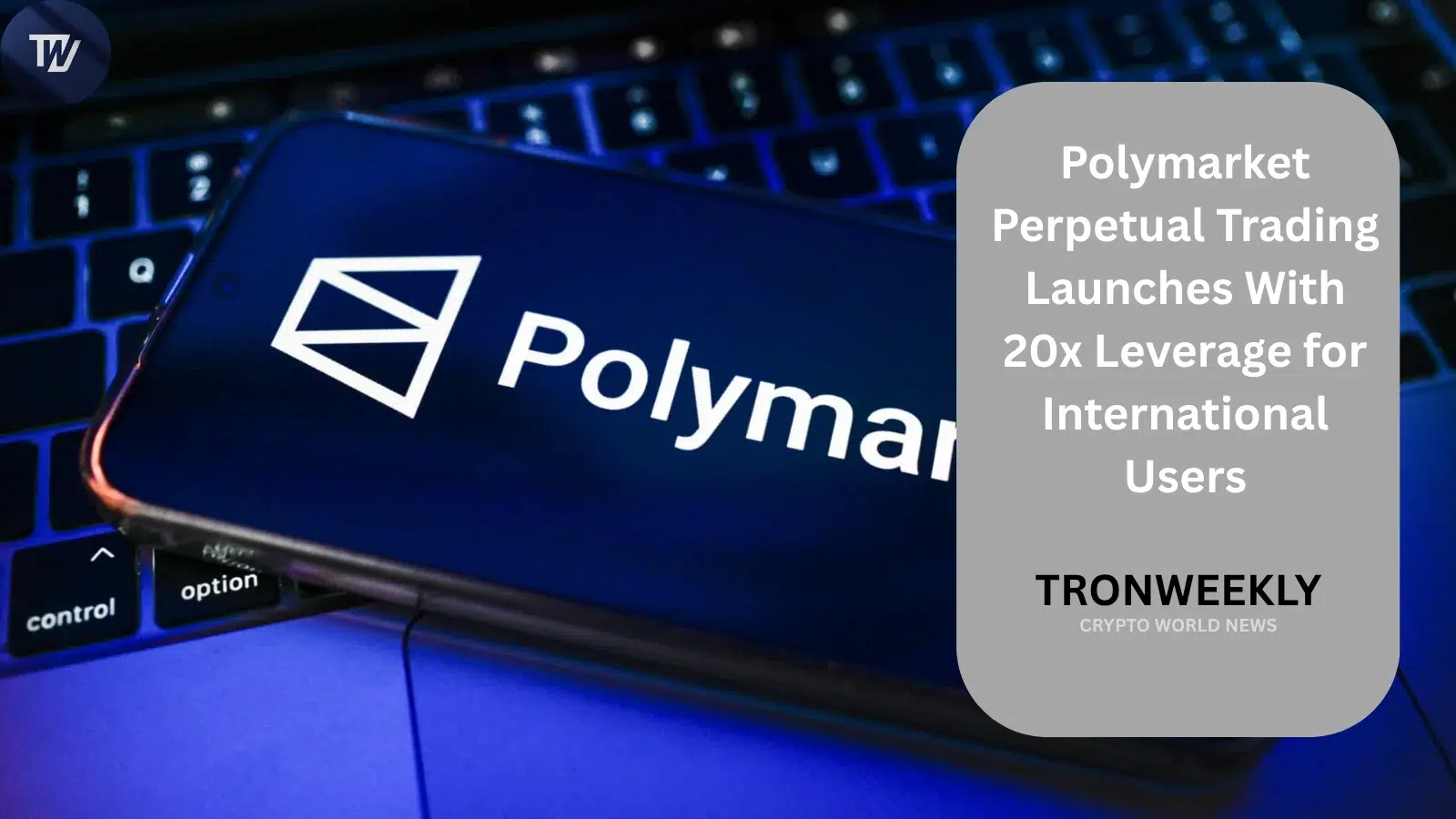
Polymarket Perpetual Trading now allows users worldwide to trade crypto assets, stocks, indices, and commodities on a single platform. Perpetual Futures Launched on Polymarket With Up to 20x Leverage for Traders in Multiple Asset Classes. Investors have the ability to either go long or short while using leverage of up to 20x.
Table of Contents
Polymarket Perpetual Trading Expands Into Multiple Markets
Polymarket’s perpetual trading system has 10 markets to start with that include crypto assets as well as traditional financial assets. Bitcoin (BTC), Ethereum (ETH), Solana (SOL), and Hyperliquid (HYPE) are some of the initial crypto markets that have been provided by the platform.
Some other initial markets offered by the platform include gold, silver, S&P 500, Nasdaq 100, WTI oil, and SPCX. Traders can place a long position as well as a short position and use up to 20x leverage.
According to Polymarket, their perpetual futures market is designed to offer deep liquidity and low fees. The service will be available to the international community in jurisdictions where it is legal.
Such an expansion would also allow users to hedge against economic events. These events may include decisions by the Federal Reserve, interest rate hikes, and the movements of the stock indices.
Also Read | XLM Price Eyes $0.30 as Bullish Setup Meets Expanding USDT Liquidity
Perpetual Futures Take Polymarket Beyond Predictions
Polymarket perpetual trading is definitely a step forward from the current prediction market platform provided by the firm. In contrast to regular futures, which usually have an expiry date, perpetual futures don’t have one.
As long as traders continue to cover their positions with the necessary amount of margin, they can hold their positions for as long as they want.
Moreover, the firm aims at scaling up the trading infrastructure’s capacity. Polymarket aims to achieve 200,000 orders per second, which will be approximately fifteen times higher than the present one.
In terms of the long term, Polymarket’s architecture has been designed for processing over 400,000 orders per second. According to preliminary tests, there has been a ten- to twenty-fold improvement in p99 latency, a metric measuring slower order processing times.
US Polymarket Trading Remains Under Regulatory Rules
While Polymarket perpetual trading has been launched globally, US availability continues to be governed by regulatory criteria. The derivatives products provided to US clients need to conform to regulations set by the Commodity Futures Trading Commission (CFTC).
Another important point raised by Polymarket was that self-certification of a contract does not imply any formal approval of the CFTC of that contract. It may still choose to examine or delay the contract before launching it for trade.
The perpetual futures products will also be distinct from the crypto price event contracts in Polymarket. Users can make predictions on whether the price of Bitcoin, Ethereum, Solana, and other cryptocurrencies will hit certain price targets at a certain time.
In Polymarket perpetual trading, users get leverage via long and short positions without an expiration date for the contract.
This is yet another milestone for Polymarket as it strives to expand its operations to become a financial trading platform for prediction markets and leveraged trading of crypto and regular assets.
Also Read | Crypto ETNs Reach 2 Million Investors Through Hargreaves Lansdown