Senate Republicans released a revised 635-page CLARITY Act ahead of Tuesday’s procedural vote, adding tougher ethics limits and new stablecoin safeguards. The crypto bill is designed to answer Democratic objections while preserving a path to further Senate debate.
Table of Contents
Senator Cynthia Lummis released the final draft with Tim Scott and John Boozman. Their office said the market structure bill includes 126 substantive changes requested by Democrats after more than a year of negotiations.
The Senate is scheduled to vote on cloture on the motion to proceed on September 15. The vote needs 60 senators and would only determine whether the chamber advances to debate. It would not amount to final passage.
President Donald Trump also accepted key parts of an ethics proposal developed by Republican Senator Thom Tillis and Democratic Senator Ruben Gallego. An aide told The Associated Press that Trump accepted roughly 80% of their proposal, including state attorney general enforcement.
What Would the CLARITY Act Change for Officials?
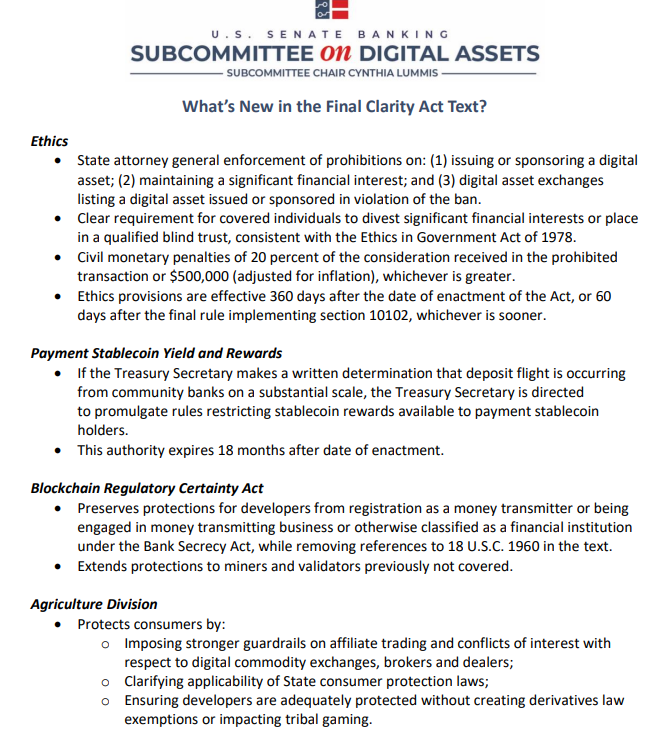
The amended CLARITY Act prohibits covered individuals from issuing or sponsoring digital assets in return for payment. Also, a range of significant financial interests is not allowed unless the covered individuals sell their stakes or put them into a qualified blind trust.
Also Read: DOJ Crypto Seizure Targets Xinbi in $52M Crackdown
Under the proposed amendment, a significant financial interest includes equity worth at least $15,000. The threshold is adjusted for inflation.
It applies to businesses that earned a plurality of their revenue from issuing or sponsoring digital assets in any of the past three years. The rule targets business ownership, not crypto held in wallets.
Covered individuals under the draft law include federal public officials and employees, elected presidents, vice presidents, and members of Congress before becoming a member, as well as covered spouses. The Republican summary adds to this list federally elected officials and judges and their spouses.
State attorneys general will be responsible for enforcing the new prohibitions, including prohibited issuance or sponsorship, significant financial interest, and listing by the exchange of assets issued contrary to prohibition.
Individuals who violate the prohibitions against issuance and sponsorship knowingly and willfully will face civil penalties equaling either $500,000, adjusted for inflation, or 20% of the consideration. Another penalty will apply to a significant financial interest prohibited.
The ethics provision will enter into force 360 days after enactment or 60 days after the publication of the implementing rule, whichever occurs first.
When Could Treasury Restrict Stablecoin Rewards?
The crypto bill also authorizes the Treasury Secretary to make a temporary response to deposits fleeing community banks. The provision would activate after a finding of significant deposit flight. It would then restrict rewards available to payment stablecoin holders.
This authority shall expire after 18 months from the date of its enactment. The Republican sponsors have indicated that this provision is meant to protect community banks from the risks involved.
How Would Developer Protections Change?
This new version of the Blockchain Regulatory Certainty Act maintains safeguards for software developers that have no control over customer funds. The law would exempt eligible developers from having to register as money transmitters and be treated as a financial institution under the Bank Secrecy Act.
In its final form, the act will not make any mention of Section 1960 of Title 18, which deals with unlicensed money transmitters. This new version of the act also adds protection for miners and validators, with Republican lawmakers calling the rest civil safe harbors.
What Changes for Digital Commodity Platforms?
The section concerning the Agriculture Committee tightens rules regarding conflicts of interest for affiliates related to digital commodity exchanges, brokers, and dealers. This section also makes clear that any state consumer protection laws will still be applicable.
The section does protect developers but doesn’t create exceptions for derivatives law or limit the Commodity Futures Trading Commission’s existing powers. The Republican negotiators have also said that the changes do not affect tribal gaming.
Why Did CLARITY Act Polymarket Odds Rise After the Final Draft?
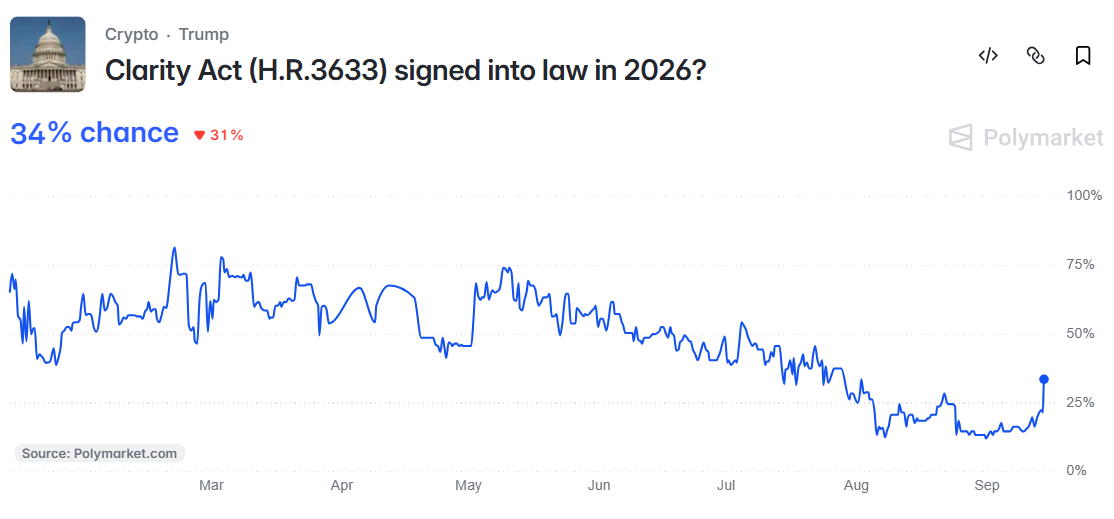
Prior to the publication of the final CLARITY Act text, Polymarket traders were still wary. The bill was given only a 20% probability of being enacted into law in 2026 on September 12, displaying lack of confidence prior to the offer from Republicans.
The enactment possibility has been priced at roughly 34% by Polymarket, marking an increase of 14 percentage points from its September 12 value. It needs to pass through the House and Senate as well as get the signature of the president by December 31.
The vote on Tuesday will be seen to see whether the rewritten CLARITY Act can survive. Although the 60-vote mark will be surpassed, it is still going to be a long journey for the market structure legislation.
Also Read: CLARITY Act Faces Crucial Sept. 15 Senate Vote as 60-Vote Test Looms