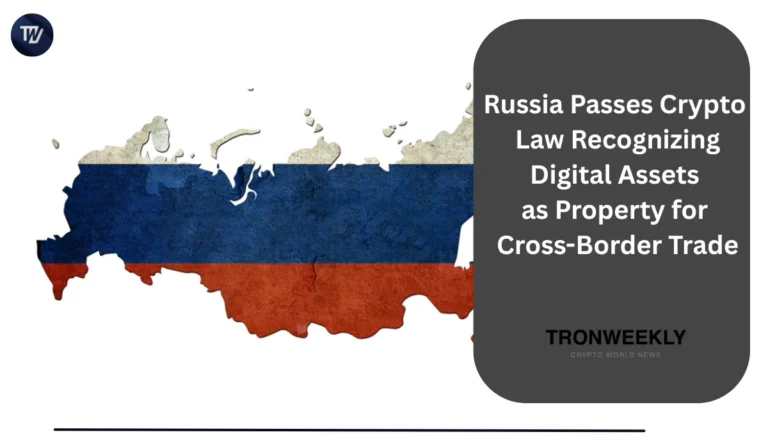
Russia’s State Duma passed a law recognizing cryptocurrency as a legitimate property and establishing a state-controlled regime for the employment of digital assets in international trade. On this, a move was made from a period of uncertainty to a period of regulated integration, as the Bank of Russia and the Ministry of Finance were appointed key monitoring bodies.
What the Bill Contains
The document defines crypto as property under civil law thereby, providing legal standing for ownership, inheritance and contract performance. It authorizes the introduction of a pilot regime for foreign settlement through digital assets, under supervision of the state authorities and subject to approval of financial institutions.
Source: Central Bank
Licencing exchanges and payment providers in this segment and compliance with the requirements for AML/KYC put in place by Rosfinmonitoring is mandatory
Also Read: Bitmine Nears 5% of Ethereum Supply as Crypto Treasury Hits $11.5 Billion
A Regulated Bridge for Cross-Border Trade
The new law brings a legally regulated means for Russian enterprises to work with foreign partners, since standard payment systems are still being restricted. This law mainly impacts the business side of institutions, their exporters and exchanges looking for clarity in the form of regulation, while creators of custody & compliance solutions benefit by being placed at legal certainty.
This setup will also be an illustration of how sovereign states could use their blockchain networks like Bitcoin, Ethereum and stablecoins to reduce dependence on SWIFT by a great level without totally removing their restrictions on retail access from within.
Also Read: Russia Crypto Regulation Bill Set for Decisive State Duma Votes on July 21
State Control Over Geopolitical Crypto Use
The new bill is following the bigger story of nations using crypto as settlement in fragmented geopolitical conditions.By not allowing full liberalisation, Russia’s model maintains state control and only exposes retail investors to limited risks while offering institutional investors more avenues.
This measures will be the adoption of rules that govern regulation, the choosing of pilot participants and working with partner countries. The outcome will rely a lot on liquidity, willingness of counterparties, and the fact if mainstream exchanges get integrated with this regulated channel.
Also Read: Vietnam Sets Fines Up to $1,900 for Unauthorized Crypto Trades