• Skip to primary navigation
  • Skip to main content
  • Skip to primary sidebar
  • Skip to footer
  • About TronWeekly
  • Write for us
  • Terms and Conditions
  • Privacy Policy
  • Disclaimer
  • Contact
  • All Posts
  • Advertise

TronWeekly

Crypto World News

  • Home
  • Latest News
  • Opinion
    • Education
    • Best TRON Wallets
    • Beginner’s guide to TRON
    • Tron Tokens
    • Market Analysis
  • Industry
    • Tron Exchange
    • Project Review
  • Press Release
  • Bitcoin (BTC)
  • Ripple (XRP)
  • Advertise
  • About TronWeekly
    • The Team
    • Editorial Policy
    • Write for us
    • Privacy Policy
    • Disclaimer
    • Terms and Conditions
    • Contact
You are here: Home / Cryptocurrency News / Altcoin News / The GENIUS Act and MiCA: A Two-Tier Future for Stablecoins in 2026

The GENIUS Act and MiCA: A Two-Tier Future for Stablecoins in 2026

What to know:

  • The GENIUS Act and MiCA regulation will create a two-tier market for stablecoins.
  • Tier 2 stablecoins will be synthetic cash, created through wrappers, reward programs, and perimeter arbitrage, acting like money under normal conditions.
  • The regulatory landscape will require stablecoin issuers to prioritize clarity, transparency, and compliance.

By Ananthyka J | Edited By Ammar Raza,February 10, 2026, 11:45 PM

GENIUS Act

Constitutional cash or Tier 1 tokens will have well-defined redemption rights, high-quality liquid reserves, and stringent rules against yield-bearing holdings.

On the other hand, Tier 2 will consist of synthetic cash, which is created through wrappers, reward programs, and perimeter arbitrage that act like money under normal conditions but are re-priced as risk assets during panic runs.

The GENIUS Act: Distinguishing Money from Investment

The GENIUS Act presents the U.S. way in stablecoin regulation, emphasising a clear distinction between money and investment. The Act defines a boundary for “payment stablecoins, ” enhances reserve expectations, and prohibits yield-bearing holdings in order to stop stablecoins from becoming internet-scale shadow deposits.
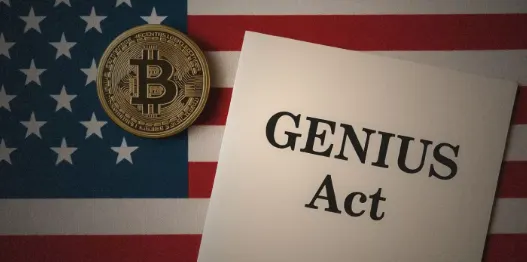
GENIUS Act
Source: Mudrex

Also Read: NY Prosecutors Raise Fraud Concerns Over GENIUS Act Enforcement Rules

MiCA: Constitutionalising Redemption Rights

On the contrary, MiCA adopts a European style, identifies the instrument, and constitutionalises the redemption right. In the case of money tokens, their promise is set out as a holder’s claim, which can be enforced at any time.

Stablecoins
Source: Federal Reserve

MiCA also reflects a concern, which regulators rarely express openly: scale changes the physics, and a frenzy in transactions can be treated as a financial stability event.

Through the regulation, explicit brakes are put on stablecoins as soon as they start to function like a mass payments rail, thereby exposing the tension between the two: adoption and financial stability.

Also Read: Coinbase CEO Warns Reopening GENIUS Act is a ‘Red Line’ for Crypto in 2025

A Two-Tier Market Emerges

Stablecoins will probably segregate themselves into different tiers as the regulatory environment becomes clearer. The stablecoin space is gearing up for a drastic change with the GENIUS Act and the Markets in Crypto Assets (MiCA) regulation, which will dramatically change the landscape.

Faced with the daunting task of following ever-changing regulations, the industry is slowly drifting towards a two-tier market setup where cash-like instruments with statutorily protected redemption rights will be alongside shadow deposits that behave like credit during panic runs.

The stablecoins’ fate is uncertain, and it is crucial for holders to place the highest emphasis on clarity, transparency, and conformity if they want to prosper in this nascent two-tier market.

Also Read: Over 125 Crypto Groups Oppose GENIUS Act Expansion on Stablecoin Rewards

Filed Under: Altcoin News, Cryptocurrency News, Market Analysis

About Ananthyka J

Ananthyka J is a market reporter at Tronweekly, reporting on cryptocurrency news. She covers cryptocurrency markets, blockchain technology, and digital asset regulation, focusing on Bitcoin, Ethereum, DeFi, altcoins, and crypto policy. Her reporting emphasizes clear and accurate market coverage, including crypto market movements, regulatory developments, and blockchain adoption. She holds a BA in Journalism and Mass Communication and an MA in Communication and Media Studies. She has also completed multiple media internships, follows strict editorial and fact-checking standards, and discloses potential conflicts of interest when reporting.

Primary Sidebar

Recent Posts

  • Cardano Price Faces Downside Risk Toward $0.145 Support Zone May 14, 2026
  • Bitcoin Price Outlook: $76,527 Becomes Crucial Level for Next Market Move May 14, 2026
  • ADA Price Analysis: Cardano Eyes $0.33 as $0.25 Support Holds May 14, 2026
  • Clarity Act Faces Partisan Hurdle as Senate Talks Stall in 2026 May 14, 2026
  • Binance Coin Price Prediction: BNB Eyes Explosive 61% Surge in 2026 May 14, 2026

Footer

News

  • Latest News
  • Altcoin News
  • Bitcoin (BTC)
  • Blockchain
  • Tron (TRX)
  • World

Digest

  • Meet the Founder
  • Price Winning Article
  • DeFi
  • Cyber Security
  • Crypto Scam

Industry

  • Project Review
  • Technology
  • Fintech
  • Tron Exchange
  • New in Town

Tron Universe

  • Event and Tron Parties
  • New in Town
  • Tron Tokens

FOLLOW US

  • Facebook
  • Telegram
  • Twitter
  • Linkedin

Subscribe US

Editorial Policy | Privacy Policy | Disclaimer | Terms and Conditions | Masthead

Copyright © 2026 · Tron Weekly. All Rights Reserved. NOTE: Tron Weekly is an independent crypto news site that adheres to the strict journalism policy anchored on transparency, trust, and objectivity, we have no affiliation with the TRON Foundation, its founder Justin Sun or any other cryptocurrency firm.