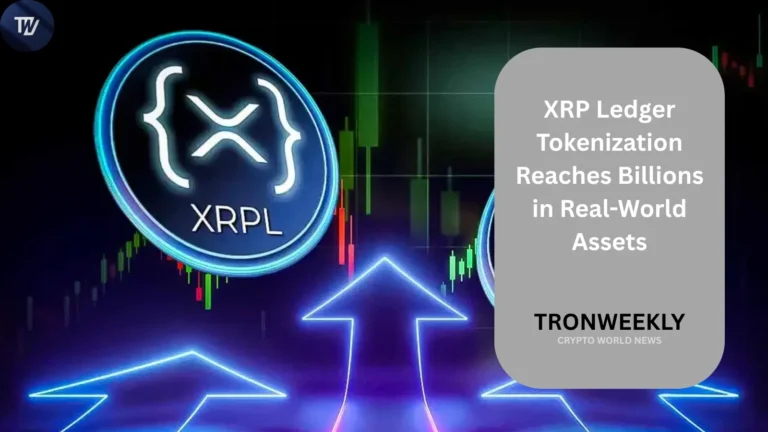
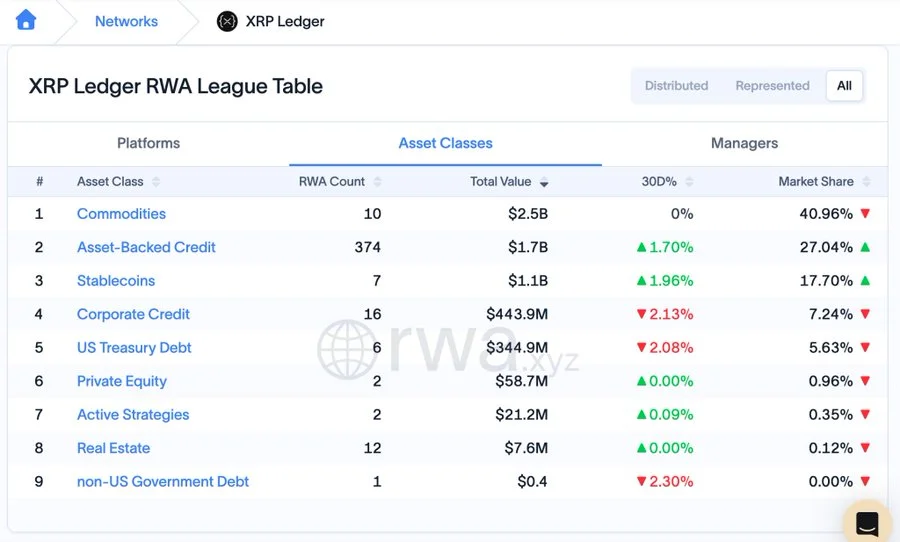
XRP Ledger tokenization is being highlighted as billions of dollars worth of RWAs are tokenized on the XRP Ledger. Commodities are dominating the market in terms of the total amount of assets accounted for on the XRP Ledger. Asset-Backed Credit, Stablecoins, Corporate Credit, and US Treasury Bonds are some other forms of RWAs that make up the increasing market of tokenized assets.
Table of Contents
As per the figures indicated, the commodity group has an estimated value of $2.5 billion, comprising 40.96% of the total RWA valuation on XRPL. It can be observed from the figures that tokenization has been used in the representation of financial market-related assets.
Also Read | Dogecoin Price Holds $0.08 as CZ Binance Highlights DOGE’s Success
Commodities Lead XRP Ledger Tokenization Growth
The total value of assets recorded on the XRP Ledger as commodities stands at about $2.229 billion for JMWH and another $280 million for diamonds collectively.
Apart from commodities, there are other asset categories that form part of the recorded values on the XRP Ledger. They include $1.7 billion for asset-backed credit and $1.1 billion for stablecoins, $443.9 million for corporate credit, and $344.9 million for US Treasury bonds.
These numbers show what kind of financial assets are currently being tokenized on the network. XRP Ledger Tokenization is not only concerned with the tokenization of cryptocurrencies but also includes attempts to create digital records of traditional assets using blockchain technologies.
Nevertheless, one should not consider these numbers as equal to the market capitalization of XRP or investments made in XRP. The valuation of tokenized assets does not include the market valuation of the token.
XRP Ledger Tokenization Gains Institutional Attention
Blockchain projects undertaken by institutions are giving practical illustrations of how traditional financial firms are experimenting with blockchain technology. It is significant since financial institutions usually require defined records of ownership, defined custodial arrangements, and regulatory compliance when developing new financial instruments.
Aviva Investors made an announcement on July 30, 2026, that a tokenized share class for its US Dollar Liquidity Fund was available on the XRPL platform after gaining approval from the Central Bank of Ireland. This is an illustration of an asset management firm experimenting with blockchain technology regarding fund ownership.
The assets of the fund will be kept with BNY Mellon while specialists will offer digital custody and tokenization services. This structure will enable the fund to experiment with blockchain representation without transferring its assets out of its custodian.
This development enhances the narrative of the Tokenization story on the XRP Ledger because it demonstrates the potential that blockchain technology can bring to traditional financial products. The exact implications for the digitization of fund shares will vary depending on the specifics of their implementation.
Ripple and CSD BR Explore Tokenized Fund Records
Ripple and Brazilian financial market infrastructure provider CSD BR jointly announced a collaboration to tokenize the ownership details of BTG Pactual investment fund shares on the XRPL on September 29, 2026.
CSD BR will maintain the security registry, and XRP Ledger will maintain the ownership details. The initiative is an example of how blockchain technology can help the traditional financial markets without interfering with the existing systems.
Why XRP Ledger Tokenization Matters for Real-World Assets
Tokenization of real-world assets involves the representation of assets, including government securities, commodities, investment funds, and real estate as digital tokens.
XRP Ledger Tokenization can be useful for institutions that wish to explore blockchain technology for managing assets and offering financial services. Adoption of the process may depend on regulation, liquidity, demand from investors, custody, and interoperability.
Current statistics reveal the tokenized assets of XRPL, while the use cases for institutions provide information about future possibilities.
What XRP Ledger Tokenization Could Mean for XRP
Increased tokenization activities might help boost the importance of the XRP Ledger in the sphere of digital finance. However, there is no direct impact that such activities have on the market capitalization of XRP.
There is a distinction between the XRP token itself and any other asset created or represented on XRPL. Tokenized shares, commodity-linked instruments, or credits do not need the equivalent amount of XRP to be bought or kept.
It all depends on how each use case works, which functions are implemented by means of XRP, and whether fees, liquidity, etc. are required in the form of XRP. An increase in the activities in the network might help make it more relevant; however, the overall capitalization of all tokenized assets does not influence the price of XRP.
Currently, XRP Ledger tokenization is being developed for several kinds of assets, which include commodities, credits, stablecoins, and government bonds. At the same time, the projects with Aviva Investors and CSD BR show how traditional finance institutions are interested in blockchain applications.
The next step will show whether these projects will actually bring results in terms of transactions and active involvement of financial institutions.
Also Read | Stablecoin Remittances Show 84% Cost Savings Over Traditional Transfers
This article contains market analysis and price predictions. These are not guarantees. Crypto markets are volatile. Always DYOR. Not financial advice.