A bigger institutional push for Avalanche from Janus Henderson. A $500 billion global asset manager Janus Henderson signals a bigger institutional push for blockchain through Avalanche. In recent pronouncements, Head of Innovation Nick Cherney explained that the firm’s vision is not simply a test-and-learn approach with tokenization but to become the biggest and best asset manager in the world on the bleeding edge of technology.
For Avalanche, the move can be characterized as validation by an incumbent financial giant at a time when real-world asset tokenization is moving away from pilot projects toward broader adoption.
Table of Contents
From Tokenized Funds to Network Access
What transpired was more than a simple product launch. Janus Henderson has placed tokenized representations of its flagship funds on Avalanche the Janus Henderson Anemoy AAA CLO Fund (JAAA), which is focused on collateralized loan obligations, and the Janus Henderson Anemoy Treasury Fund (JTRSY), which holds US short-term T-bills.

Source: Binance
JTRSY has already overseen around $408 million, mostly on Ethereum, underpinning both the institutional interest for on-chain treasuries. To further democratise access, while improving efficiency and reducing counterparty risk, the new Avalanche deployment will employ tokenisation technology from Centrifuge.

The fund manager has also launched a validator node on Avalanche, giving it a stake in both protocol governance and consensus rather than simply using the chain for settlement and on-ramp purposes. The firm has also made an investment in Tranched, an on-chain credit platform with roughly $300 million in on-chain assets under management, with a pipeline of over $3 billion.
Also Read: Avalanche: Strong $5.1B Courts, $529M, 10 Chapters Now
Why Avalanche Is Attracting Institutional Capital
The significance here is that it represents a new institutional playbook: instead of treating blockchains as generic neutral pipes, large asset managers are branding support for specific ecosystems and investing to secure them. Avalanche’s high-throughput low-cost consensus platform and subnet functionality meets the compliance controls and performance requirements of institutions.
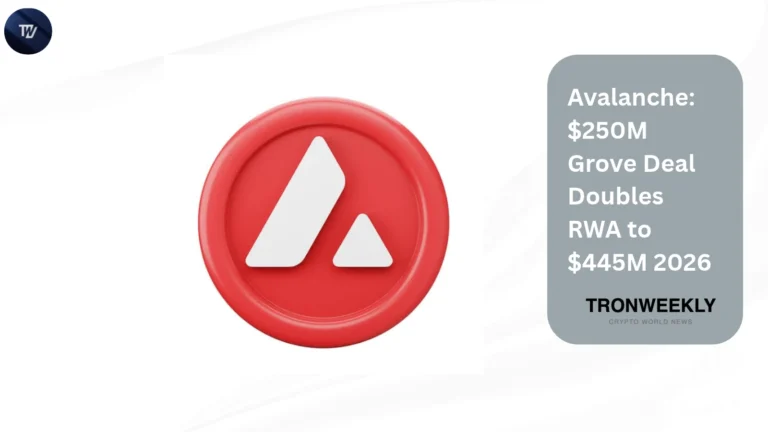
The announced $250 million Grove initiative, in partnership with Steakhouse Financial and Anemoy, will more than double the ecosystem’s real-world asset portfolio to approximately $445 million, per ecosystem reports.
That puts Avalanche on equal footing with Ethereum (which still dominates RWA markets) and with newer entrants like Aptos. For developers, that points to continued institutional demand for lending, credit, and treasury primitives; for exchanges and custodians it suggests increased custody, trading, and settlement flows driven by regulated tokenized funds rather than unpegged crypto assets and tokens.
Also Read: Avalanche Powers Massive $5T Korea Revolution Feb 4 2027
Broader Context, Stakeholders, and What Comes Next
Investors stand to benefit from new access to diversified, yield-paying assets with blockchain efficiencies, though they also face new risks, including smart contract failures, liquidity fragmentation across chains, and evolving compliance requirements. Developers on Avalanche could see increased institutional liquidity, but now need higher standards of security audits and transparency.

The development is consistent with broader trends. The tokenization of treasuries and private credit has gained momentum so long as yields are attractive and regulatory clarity emerges in core jurisdictions. Supervisory authorities are closely monitoring custody, investor protection, and interoperability, while firms are assessing, which chain to choose based on finality, costs, and ecosystem maturity.
Source: LinkedIn
Next, we expect to see JAAA and JTRSY grow on Avalanche, more validator participation from the traditional finance industry, and integration with DeFi markets where appropriate. If adoption remains robust, Avalanche will deepen its institutional presence in RWA, and Janus Henderson’s approach could be replicated by other fund managers seeking to differentiate in a new way of thinking for traditional finance.
To sum up, the Janus Henderson Avalanche approach is demonstrating how legacy asset managers are moving from experiments into active participation in a new financial system. The question for institutional adoption is whether this new phase accelerates adoption or exposes new frictions between traditional finance and spread out infrastructure in the coming years.
Also Read: Avalanche Network Activity and AVAX Price Outlook Signals Bullish Momentu