
Binance users increased their Bitcoin holdings in October while balances of Ethereum, USDT and BNB declined, according to the exchange’s latest proof-of-reserves snapshot. The shift offers a view into how assets held on one of the world’s largest crypto exchanges changed at the start of the month.
Table of Contents
Bitcoin Leads Binance User Asset Changes in October Snapshot
Binance’s October proof-of-reserves snapshot, taken on October 1, showed user Bitcoin holdings at about 688,573 BTC. That represented an increase of 6,217 BTC, or 0.91%, from the 682,356 BTC recorded on September 1. The data indicates that users held more BTC on the exchange at the latest monthly measurement.
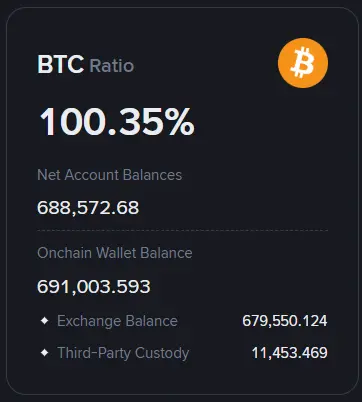
The increase occurred while Bitcoin traded around the $85,000-$87,000 range in early October. Binance Research said total crypto market capitalization rose 11% during September to $2.99 trillion, while spot Bitcoin ETFs recorded $3.49 billion in inflows during the month.
That broader demand backdrop provides context for the increase in BTC held by the exchange users, although the proof-of-reserves data cannot establish why individual users moved their assets.
Also Read: MiCA Reverse Solicitation: 281 Licensed, Huge Binance Ban
Binance User ETH Holdings Fall 4.61% in October Snapshot
Ethereum showed the opposite direction in the October snapshot. Binance reported user ETH holdings of roughly 3.799 million ETH, down 183,602 ETH, or 4.61%, from September’s 3.983 million ETH. The decline was substantially larger in percentage terms than the change in Bitcoin balances.
USDT holdings also decreased, falling 0.87% to approximately 32.03 billion tokens. BNB balances declined 0.77% to about 43.04 million tokens. Taken together, the figures show that the monthly change was not simply an increase or decrease across all major assets, but a more selective shift in the composition of assets held by the exchange users.
Binance USDT Holdings Decline 0.87% as BTC Balances Rise
The movement in stablecoin balances is relevant because USDT is widely used as trading liquidity across crypto markets. A reduction in Binance’s reported user USDT balance can reflect withdrawals, conversions into other assets or changes in trading activity, but the snapshot alone cannot distinguish between those factors. It therefore should not be treated as direct evidence of capital leaving crypto markets.
The exchange’s proof-of-reserves system is designed to let users verify that their account balances were included in the reported liabilities through a Merkle Tree and zk-SNARK-based process.
The exchange says its reserves are intended to back user assets on a 1:1 basis. However, the monthly figures remain point-in-time measurements rather than a continuous picture of every customer’s holdings.
Binance Proof of Reserves Shows 1 Key Shift in User Assets
The latest snapshot matters for users because reserve transparency provides information about the assets an exchange holds on their behalf. Bitcoin’s increase suggests that BTC represented a larger share of reported user balances in October, while the declines in ETH, USDT and BNB point to different positioning across major assets.
These figures can help readers monitor exchange-level behavior without assuming they represent the entire crypto market.
The next monthly snapshot will show whether the Bitcoin increase persists or reverses. For the exchange, continued transparency around reserves will remain important as regulators and users place greater emphasis on custody and asset backing.
The exchange also faces ongoing regulatory scrutiny in Europe, where authorities are examining its operations under the EU’s MiCA framework, making reserve disclosures one part of a broader transparency and compliance picture.
Also Read: Binance Pay USDT Enables Payments at PayPay Merchants Across Japan