Cardano price is facing renewed pressure as cooling momentum raises concerns over whether buyers can defend key support levels following the retreat from October’s peak.
In addition, the Cardano Foundation is broadening blockchain education via a program at the University of Nicosia in Cyprus, bringing a longer-term adoption angle into the network’s narrative.
Table of Contents
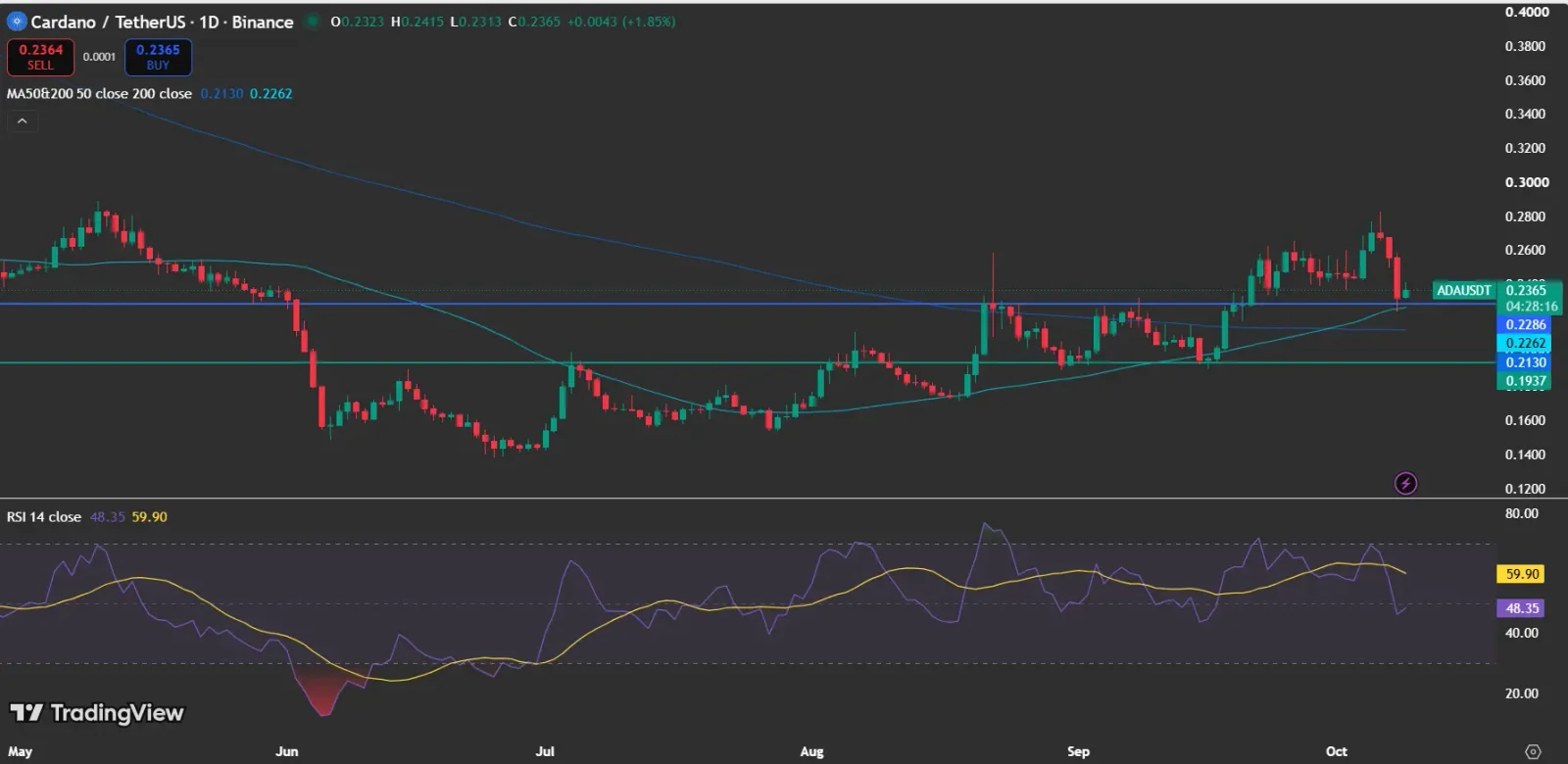
As of press time, Cardano (ADA) is changing hands at $0.2365, and the daily candle on display reflects a 1.85% gain.
According to the TradingView chart, ADA continues to trade above both its 50-day and 200-day moving averages, even though its Relative Strength Index (RSI) indicates that bullish momentum has eased.
Also Read: Cardano Expands RealFi Push as ADA Price Setup Gains Attention
What Is Putting Pressure on Cardano Price Following Its Rally?
On the daily TradingView chart, ADA can be seen recovering before pushing up toward $0.28 in early October. Since then, the price has retreated to $0.2365, suggesting that buying momentum has weakened following the recent rally.
Even with that pullback, ADA is still positioned above its displayed 50-day moving average of $0.2130 and 200-day moving average of $0.2262. Should selling pressure persist, the 200-day moving average could act as near-term support, while the 50-day moving average represents a lower support area. A sustained move below these levels would weaken the current technical setup.
Can Cardano Price Stay Above $0.2286?
The chart marks $0.2286 as a nearby support level that traders might keep an eye on throughout the present pullback. If ADA remains above this zone and buyers step back in, the price may make another attempt at recovering toward its recent October high.
Should $0.2286 give way, the 200-day moving average around $0.2262 could come into view. Because these levels are close together, a break below $0.2286 would not, by itself, confirm a deeper decline.
A sustained move below the 200-day moving average would provide stronger evidence of further technical weakness.
Also Read: Cardano Price Rises 3% as a Nine-Year Milestone Fuels Optimism
What Does the RSI Tell Us About Cardano Price?
At present, Cardano’s RSI sits at 48.35, which is beneath its RSI average of 59.90. That reading has slipped under the neutral 50 mark, signaling that upward momentum has lost strength relative to the prior rally.
On its own, the indicator does not confirm a lasting bearish trend. A move back above 50 might point to strengthening momentum, whereas a deeper decline combined with a support break would strengthen the possibility of continued downside pressure.
Also Read: ADA Price Gains Attention as Cardano Expands Trustless Payment Use Cases
How Might University Education Shape Cardano Adoption?
As stated in a post that Cardanians shared on X, the Cardano Foundation is extending Cardano education to the University of Nicosia in Cyprus via its Blockchain and Digital Assets course. This effort familiarizes students with the basics of Cardano within an academic environment.
Such a step might raise awareness of blockchain technology among the developers and professionals of tomorrow. Still, the announcement does not prove that this effort has boosted demand for ADA or had a direct effect on its present price.
The initiative is therefore best understood as a longer-term ecosystem development rather than an immediate price catalyst. Evidence of increased network participation or sustained growth in usage would be needed to assess its impact on adoption.
Also Read: ADA Price Gains Attention as Cardano Expands Trustless Payment Use Cases
What Lies Ahead for Cardano Price?
Whether the current pullback stabilizes will depend on Cardano’s price action around $0.2286 and its 200-day moving average near $0.2262.
If the recovery continues, the October high of roughly $0.28 may come back into focus, while a breakdown could shift attention to the 50-day moving average around $0.2130 as a lower support level.
What Do DeFiLlama and CoinGlass Data Reveal?
DeFiLlama‘s data on Cardano’s total value locked (TVL), DEX volume, and active addresses provides insight into DeFi activity and network participation.
CoinGlass data on futures open interest, trading volume, and liquidations offers a broader view of ADA derivatives activity and trader positioning.
Together, these metrics can help assess ecosystem activity and market sentiment, although they cannot independently confirm growing adoption or predict future price movements.
What Should Traders Watch Next?
The University of Nicosia initiative supports Cardano’s longer-term ecosystem development, although its impact on adoption remains unconfirmed. T
raders can monitor support levels, RSI momentum, DeFiLlama’s network metrics, and CoinGlass’s derivatives data to gain a broader understanding of Cardano’s market conditions.
Crypto markets remain highly volatile, so traders should monitor price action, market sentiment, and upcoming catalysts while carefully assessing risks before making investment decisions.
Also Read: ADA Price Gains Momentum as Cardano Infrastructure Development Expands
This article contains market analysis and price predictions. These are not guarantees. Crypto markets are volatile. Always DYOR. Not financial advice.