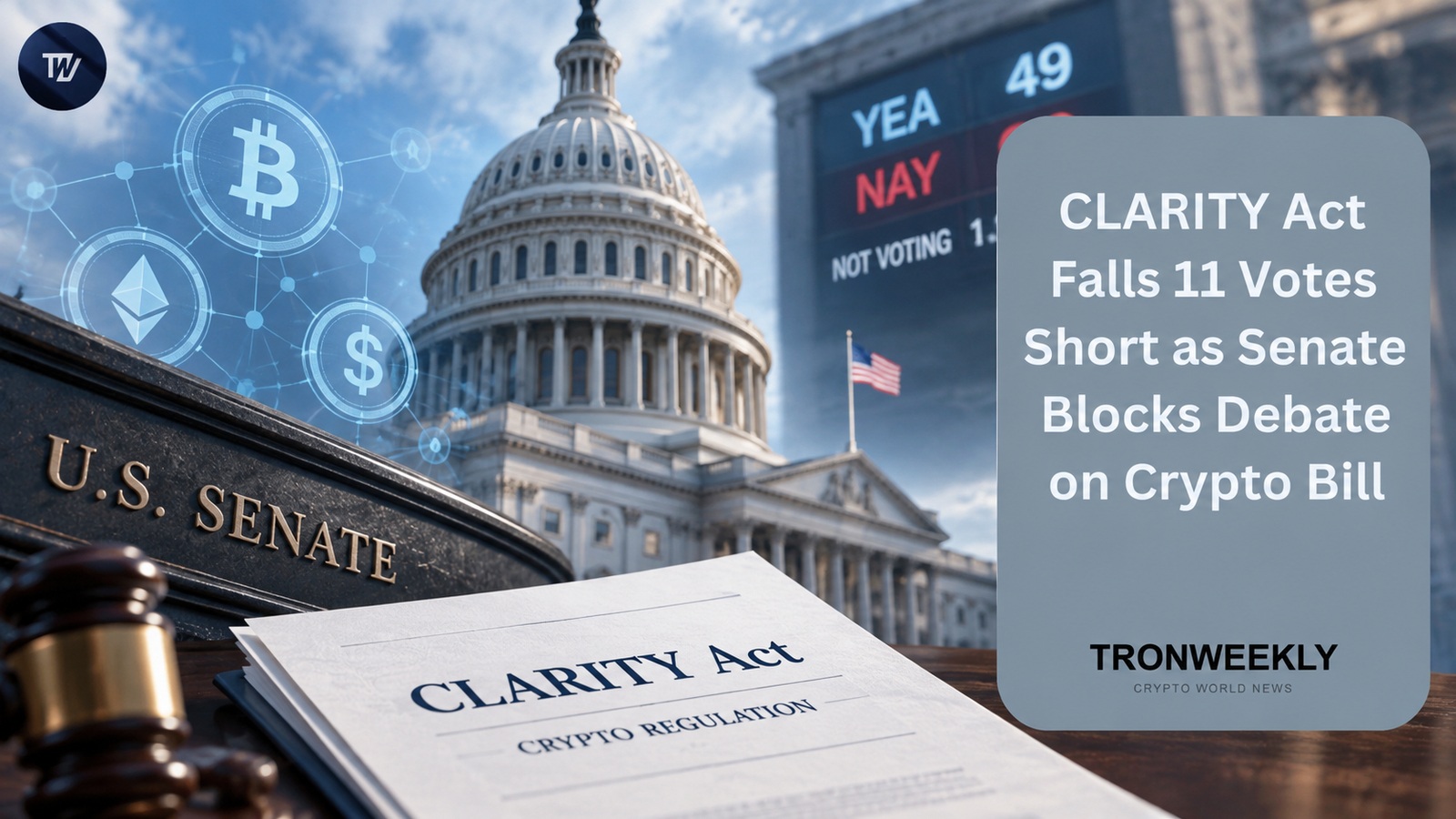
The CLARITY Act failed in the U.S. Senate because the body declined to advance the procedural motion that would allow debate on the market structure bill for digital assets. The 49-50 vote was 11 votes shy of the majority needed to achieve cloture.
Table of Contents
The vote on September 15 was on the motion to proceed with H.R. 3633, the Digital Asset Market Clarity Act. It was not on the final vote for passage. Cloture would have opened Senate debate on the legislation.
The official record of votes on the Senate floor states that 49 senators supported cloture while 50 senators opposed it. Senator Chris Coons abstained from voting. Senator Thom Tillis voted “no” in order to reconsider the bill.
Why Did the CLARITY Act Vote Fail?
CLARITY Act legislation had to be bipartisan, as Republicans did not have the 60 cloture votes. Talks had been held regarding government ethics, stablecoin rewards, protection for developers, and other cryptocurrency regulation measures.
Also Read: US 10-Year Treasury Yield Breaks 5% as Oil and Fed Risks Build
President Donald Trump agreed to ethics clauses prior to the vote. New restrictions were imposed for some crypto activities for federal officials. Also, state attorneys general were granted the right to enforce some provisions of the ethics framework.
Democrats claimed that the language in terms of government ethics was not sufficient enough. They pointed out the issue of conflicts of interest in the case of crypto investments and businesses connected to high-ranking government officials.
One of the other key disputes was that of stablecoin rewards. Banking lobbies advocated for stronger restrictions since reward-bearing stablecoins can attract deposits from insured banks. Crypto companies, on the other hand, refused such restrictions.
Developers also sought stronger protections for non-custodial software. The debate centered on whether developers should face liability when they create tools that do not directly control customer funds.
What Happens to the Crypto Market Structure Bill Now?
Failure in passing this bill stalled the imminent debate of the measure in the Senate. Tillis kept a procedural means open through voting no prior to filing a motion for reconsideration.
This does not necessarily mean a second vote will take place. According to Reuters, the bill remains dormant as Congress heads towards a recess prior to the November midterm elections.
The bill got a 294-134 vote in the House of Representatives in July 2025. A new draft was later formulated in the Senate with different language from the one passed by the House of Representatives. This requires approval in the House once again should it pass the Senate.
Since the bill from the Senate is not the same as the bill that passed the House, passage of the bill in the Senate would not go straight to Trump’s desk. It needs to be the same in both houses.
How Would the CLARITY Act Change Crypto Rules?
The crypto market structure bill is aimed at allocating digital asset regulation between the Commodity Futures Trading Commission and the Securities and Exchange Commission more precisely.
According to the new approach, the CFTC should be responsible for digital commodities and spot-market intermediaries. The SEC should have authority in relation to assets and transactions subject to federal securities laws.
The new framework was also designed to classify tokens. There was a proposal to consider XRP a digital commodity in secondary-market dealings irrespective of Ripple’s positions.
None of those provisions can come into force without Congressional approval of the law and its signing by the president. Consequently, the existing powers of the SEC and CFTC stay the same.
How Did Markets React to the Failed Vote?
Bitcoin dropped over 5% after the vote seemed destined to fall through. Shares of Coinbase and Circle also saw drops of up to 10% in the trading session.
The move was a result of the lack of any immediate regulatory impetus. The Senate was just considering starting the debate process; however, this move decreased the probability of passing the act.
This situation leaves institutions without the market structure that is being requested from the federal government by numerous crypto firms. The regulators still have the ability to regulate according to existing laws, which could be subject to litigation or future regulation.
The CLARITY Act is left unpassed instead of passed. The next move for it depends on whether the senators will decide to start new negotiations.
Also Read: ARB Price Eyes Stron Recovery With Standard Chartered’s $10 Target