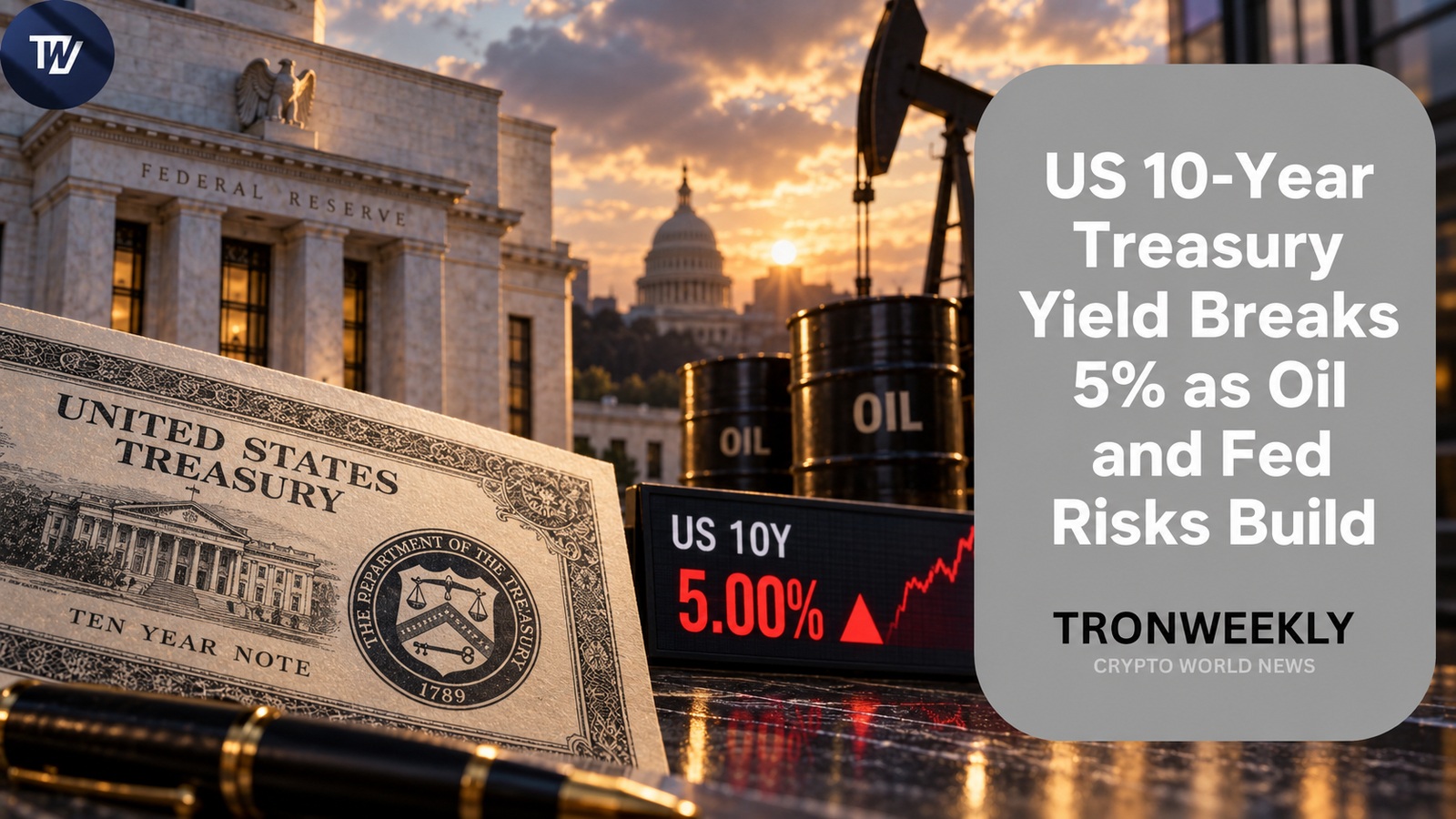
The US 10-year Treasury yield climbed above 5% on Tuesday, reaching its highest level since 2007 as oil prices and inflation concerns pressured bond markets. The move came one day before the Federal Reserve’s September 16 interest-rate decision.
Table of Contents
Reuters reported that the benchmark rate reached 5.0266% on September 15. That exceeded the October 2023 peak near 5.021%.
The move followed Monday’s break above 5%. US Treasury data placed the official 10-year par yield at 4.97% on September 14, up from 4.79% at the start of September.
Bond prices move in the opposite direction to yields. The latest Treasury yield increase reflects renewed selling as investors reassess inflation, energy costs, and monetary policy.
Why Is the Treasury Yield Rising?
The price of oil continues to be a significant factor. On Tuesday, Brent crude rose past $107 a barrel amid the attack on Saudi infrastructure and the failure of Gulf-Iran negotiations.
Also Read: Republicans Push 126 CLARITY Act Changes Ahead of Senate Test
The East-West pipeline of Saudi Arabia was closed following the attack. The pipeline can transport several million barrels of crude oil per day and serves as a replacement for the Strait of Hormuz.
Rising oil prices can translate into higher costs for transportation, production, and consumers. This connection has added to worries that inflation would remain above the Fed’s 2% target.
The yield on the Treasury has also been bolstered by large-scale borrowings of the US government and expectations of stricter monetary policy. Reuters cited those factors as ones that weighed on long-dated bonds.
Interest rates on long-term lending continue to be quite high. According to the Treasury data, the 20-year yield was 5.37%, and the 30-year yield was 5.34% on September 14. The 30-year yield was 5.27% on September 1.
How Are Stocks and Crypto Reacting?
An increase in government bond yields has been contributing to competition in terms of seeking capital from investors. Government bond yields provide a risk-free rate of return guaranteed by the US government, while stocks and cryptocurrencies expose investors to price risks.
Monday closed with Wall Street in the red zone, as the S&P 500 index declined by 0.48% to end the day at 7,619.94, the Nasdaq Composite index fell 0.56% to close at 26,186.41, and the Dow index shed 0.29%.
Chip stocks fell even harder due to a different reason. The Philadelphia Semiconductor index was down 5.9% following calls for a slowdown in the development of more advanced systems for AI due to safety considerations.
Cryptocurrency markets faced additional selling pressures due to elevated bond yields and oil prices, as Bitcoin and Ether fell during Tuesday’s trade on reduced exposure to risk assets. The effect of Treasury yields on Bitcoin is significant because Bitcoin cannot offer a cash return to investors.
A stronger dollar was an additional challenge. Reuters noted that elevated oil prices, US yields, and reduced risk appetite were pushing the dollar closer to a two-week high.
What Will the Federal Reserve Decide?
The Federal Reserve started its September 15-16 meeting with the federal funds target rate standing at 3.50%-3.75%. However, in July, the officials left the range unchanged while three policymakers favored a 25-basis point hike.
Investor sentiment has moved substantially since then. According to Reuters, the probability of a quarter-point hike was around 93%, according to CME FedWatch pricing on Tuesday.
In that case, the range will go up to 3.75%-4.00%. Investor expectations are reflected in market pricing and do not necessarily mean the same decision as the Federal Reserve.
The Treasury yield will be another important market signal before the Fed decision. Investors will see whether the Federal Reserve views higher energy prices as a one-time shock or as an inflation risk.
The policy statement will be issued at 2 p.m. ET on September 16. The press conference by the Federal Reserve Chair Jerome Powell will follow at 2:30 p.m. together with the release of economic and interest rate projections.
As far as the markets are concerned, the next movement in the Treasury yield depends on the Fed’s stance, inflation expectations, oil prices, and appetite for bonds. A rise above 5% made borrowing costs grow and put additional pressure on risk assets.
Also Read: DOGE Price Eyes $0.093 Rally as Ascending Channel Supports Recovery