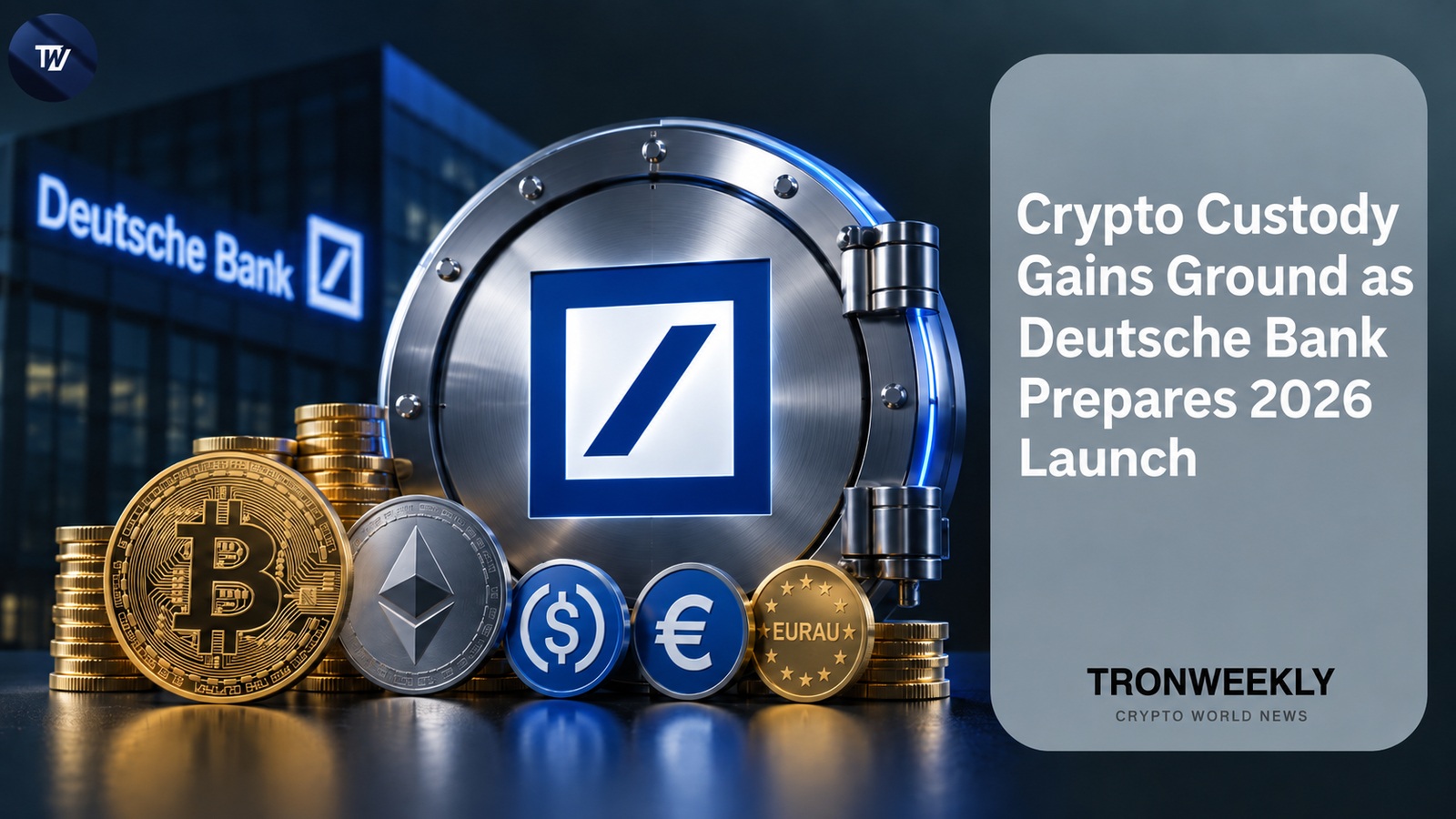
Deutsche Bank plans to launch a crypto custody service for institutional and corporate clients later in 2026. The platform will initially support Bitcoin, Ethereum, and selected regulated stablecoins, while the launch remains subject to completion of the bank’s regulatory process.
Table of Contents
The German financial institution has stated that the customers will be able to secure their digital assets. Customers will also be able to send digital assets to any other party. Deutsche Bank will be taking care of wallets and private keys.
Initially, the digital asset wallet will be available for Bitcoin, Ether, USDC, EURC, and EURAU. The bank has also mentioned that the list is subject to change.
Who Will Use Deutsche Bank’s Crypto Custody Service?
The crypto custody services are expected to be offered to institutions and companies within Europe. According to Deutsche Bank, possible customers of this service include asset managers, hedge funds, custodians, brokers, sovereigns, corporations, and blockchain companies.
Also Read: Coinbase and Morpho Launch Massive USDC Boom Profit 2026
According to Gerald Podobnik, the co-head of Corporate Bank at Deutsche Bank, digital assets are increasingly seen as an adjunct to the traditional financial system.
The token offerings will not include all the available tokens when it starts. The initial offering will consist of Bitcoin and Ether, and for the stablecoins, USDC, EURC, and EURAU.
Whether the bank will add any more token offers later depends on the demand and the bank’s approval procedure.
Why Is EURAU Part of the Initial Asset List?
The service will get access to the regulated German digital asset market through EURAU. AllUnity started offering the euro stablecoin in July 2025 when it was granted an electronic money institution license by BaFin.
The project is a collaboration between DWS, Flow Traders, and Galaxy. EURAU is described as fully backed and MiCA-compliant.
USDC and EURC stablecoins by Circle offer dollars- and euros-backed digital currencies. Their presence in the Deutsche Bank custody product for institutional clients means that regulated stablecoins are now alongside Bitcoin and Ether.
How Will Deutsche Bank Protect Client Assets?
Management of clients’ private keys by the bank is among the services that will be offered under the custody model. The security framework at the bank will comprise the following elements: key protection through hardware, key generation, and transaction approval processes.
Another aspect to be considered by Deutsche Bank is separate storage of assets in a warm environment and a cold environment. Segregation of duties, multilateral approvals, backup, and recovery control will be among the components of the infrastructure.
Audit trails, cryptographic key management, and incident response have been previously noted by the bank in relation to the platform.
What Role Do Taurus and Bitpanda Play?
Deutsche Bank has collaborated with third-party providers of digital-asset infrastructure when building custody services. In 2023, Deutsche Bank signed a global contract with the Swiss company Taurus for cryptocurrency, digital currency, and tokenized-asset infrastructure.
Taurus continues to name Deutsche Bank as one of the financial institutions using their infrastructure. This collaboration is an aspect of the bank’s digital asset strategy for institutions.
Deutsche Bank also has a separate partnership with Bitpanda. Since 2024, the bank has provided Bitpanda users with German IBANs and instant payment services, strengthening the exchange’s payment infrastructure in Germany.
What Regulatory Steps Remain Before Launch?
Deutsche Bank has not specified a definite launch date for its crypto custody platform as yet. However, it anticipates that the platform will be operational in the latter part of 2026 following completion of the necessary regulatory procedures.
Through MiCA, European credit institutions can offer crypto-asset services via Article 60. The institutions are required to give the required information to the relevant authority prior to the provision of such services.
The information consists of operational arrangements, internal control mechanisms, asset segregation, custody arrangements, money laundering policies, and technical arrangements. In Germany, Article 60 notification is sent to BaFin and Bundesbank.
What Comes After Crypto Custody?
Tokenized securities continue to be one of the financial institutions’ strategies within its digital asset vision. The bank confirmed that the platform is planned to go beyond cryptocurrencies and stablecoins, depending on demand, regulation, and internal clearance.
Deutsche Bank has been experimenting with tokenization technology via initiatives like the Monetary Authority of Singapore’s Project Guardian. Its initiatives include digital funds, interoperability, and asset-servicing solutions for tokenized markets.
Initially, the crypto custody solution will be restricted to a number of assets and professional customers. Launch date and asset coverage will depend on completion of the regulatory process and Deutsche Bank’s product roadmap.
Also Read: CLARITY Act Falls 11 Votes Short as Senate Blocks Debate on Crypto Bill