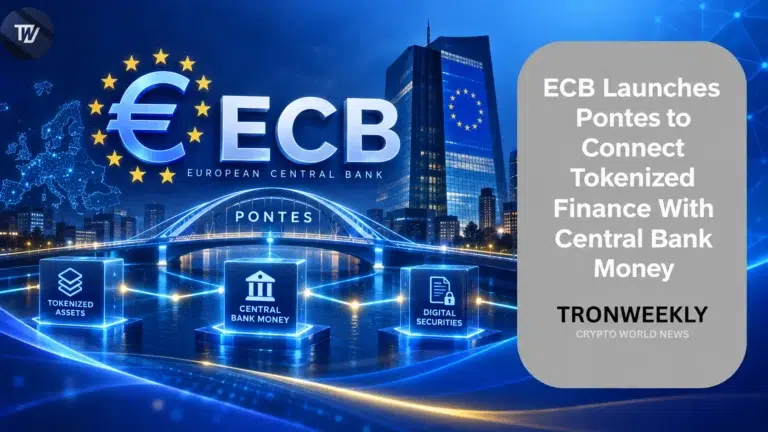
The European Central Bank has launched Pontes for wholesale tokenized settlement in central bank money. The move also comes as the ECB separately prepares to invest part of its €23 billion portfolio in digital securities.
Table of Contents
What Is ECB Pontes, and How Does It Work?
According to a Reuters report, ECB Pontes connects distributed ledger-based systems employed by banks with the TARGET Services of the Eurosystem. This connection makes it possible for tokenized asset trades to be settled via central bank euros rather than using only privately held settlement assets.
Among the earliest banks to onboard are Deutsche Bank, Santander, and Clearstream. The service will run between 8 a.m. and 4 p.m. CET on business days.
Also Read: SoftBank Junk Bonds Rise as Company Plans $11 Billion OpenAI Funding
This marks the move of a lengthy Eurosystem project into the implementation phase. Banks have been experimenting with different approaches for issuing, trading, and settling securities using distributed ledger technology.
The ECB said that central bank money must continue to serve as an anchor for tokenized finance. ECB Executive Board member Piero Cipollone noted back in March that without this, issuers of tokenized securities would end up receiving volatile assets.
How Does ECB Pontes Connect With TARGET Services?
The service connects DLT-based platforms outside the Eurosystem to its existing TARGET system. No requirement exists for the securities markets to transfer fully to a blockchain platform.
Initially, settlement finality for the cash leg would still be established within TARGET2. Further iterations of the service would establish the settlement finality on the Eurosystem-operated DLT platform.
In addition, the ECB will consider adding smart contract functionality in further iterations of the service. Such capabilities could enable automatic conditions and cut down on the number of individual settlement steps.
The new project from the ECB is based on the previous experiments with wholesale central bank money conducted by the Eurosystem. The trials analyzed how transactions on distributed ledgers could be settled against central bank money using the existing safeguards.
The central bank said that distributed ledgers could increase the speed and efficiency of transactions. The technology could integrate the stages of an asset’s life cycle and automate the processes.
When Will Pontes Expand Its Operating Model?
It should be noted that the service is going to develop after its first release. Under the previous ECB roadmap, the time when the service operates was supposed to greatly exceed the existing business day schedule.
The following goal set by the Eurosystem is 22.5 hours of availability per business day. Moreover, round-the-clock availability and programmability are planned to be achieved starting from mid-2028.
These changes will increase the flexibility of the institution to settle tokenized securities. Besides, these features will help in executing transactions that do not fit the standard European settlement times.
ECB Pontes is also implemented in connection with another ECB project called Appia that is aimed at implementing an integrated European tokenized financial system. The projects have different goals, but they are strongly interrelated.
In August, the Eurosystem has chosen 61 participants in the financial market and the public sector as members of the Appia contact group. The group will provide input on the service and the future architecture of tokenized markets.
Who Else Is Building Tokenized Market Infrastructure?
Financial organizations in Europe are also building their system simultaneously. In May, Boerse Stuttgart expanded its settlement network to include Societe Generale, SG FORGE, and flatexDEGIRO.
Seturion has been developed with a view to tokenize securities over private and public blockchain networks. This platform gives an insight into how market operators in the private sector are preparing themselves for the institutional use of DLTs.
Other central banks are also testing similar models. In Switzerland, Project Helvetia has been used to study the settlement of tokenized securities using the wholesale central bank digital currency.
The Bank of England has chosen another path to pursue this objective through the Digital Securities Sandbox. This model helps financial firms experiment with DLT-based transactions.
Even private firms have entered this market. Broadridge processed trillions of dollars through its blockchain-based repo platform in July, while European institutions have tested tokenized government bonds and structured securities.
Why Is the ECB Investing in Blockchain Securities?
Moreover, the European Central Bank (ECB) is gearing up for purchasing blockchain securities as part of its own portfolio. The plan involves setting aside a portion of its €23 billion own funds portfolio in digital securities.
In the early stage of such purchases, the ECB will stick to the top-rated euro securities of public sector issuers, making sure that the type of investment asset remains the same.
It will only be a difference in the technology involved in issuing and recording such securities instead of the credit rating.
This step follows changes to the Eurosystem collateral framework. Starting from March 30 this year, marketable securities issued via the DLT-based platform of central securities depositories have been allowed to act as collateral.
Why Is the ECB Expanding Into Tokenized Finance?
Isabel Schnabel, the Executive Board member, suggested in August that central banks should “go on-chain.” Tokenization, she argued, could streamline transactions through various stages of the process, making them programmable.
Atomic settlement and programmability have been listed among possible benefits by the ECB. Furthermore, the central bank said that traditional European settlement systems already offered certain similar services.
ECB Pontes is independent from the consumer digital euro project of the central bank. It is planning a 12-month pilot retail scheme for the last six months of 2027.
The scheme would incorporate retailers, national central banks, commercial banks, and payments providers. Invitations issued in September invited businesses operating in e-commerce and mobile commerce within the eurozone to participate in payment trials.
The goal of the central bank is to become ready for potential issuance of the digital euro in 2029. Any such issuance would require legislative approval from the EU and a separate ECB Governing Council decision.
The digital euro is aimed at offering consumers another public payment choice alongside cash and bank deposits. At the same time, ECB Pontes is targeting wholesale finance market infrastructure.
Also Read: New Zealand-India Trade Deal Passes Parliament, Opens $20 Billion Investment