
Ethereum continues to dominate the on-chain real-world asset and stablecoin market, highlighting its position as a major settlement layer for tokenized financial assets.
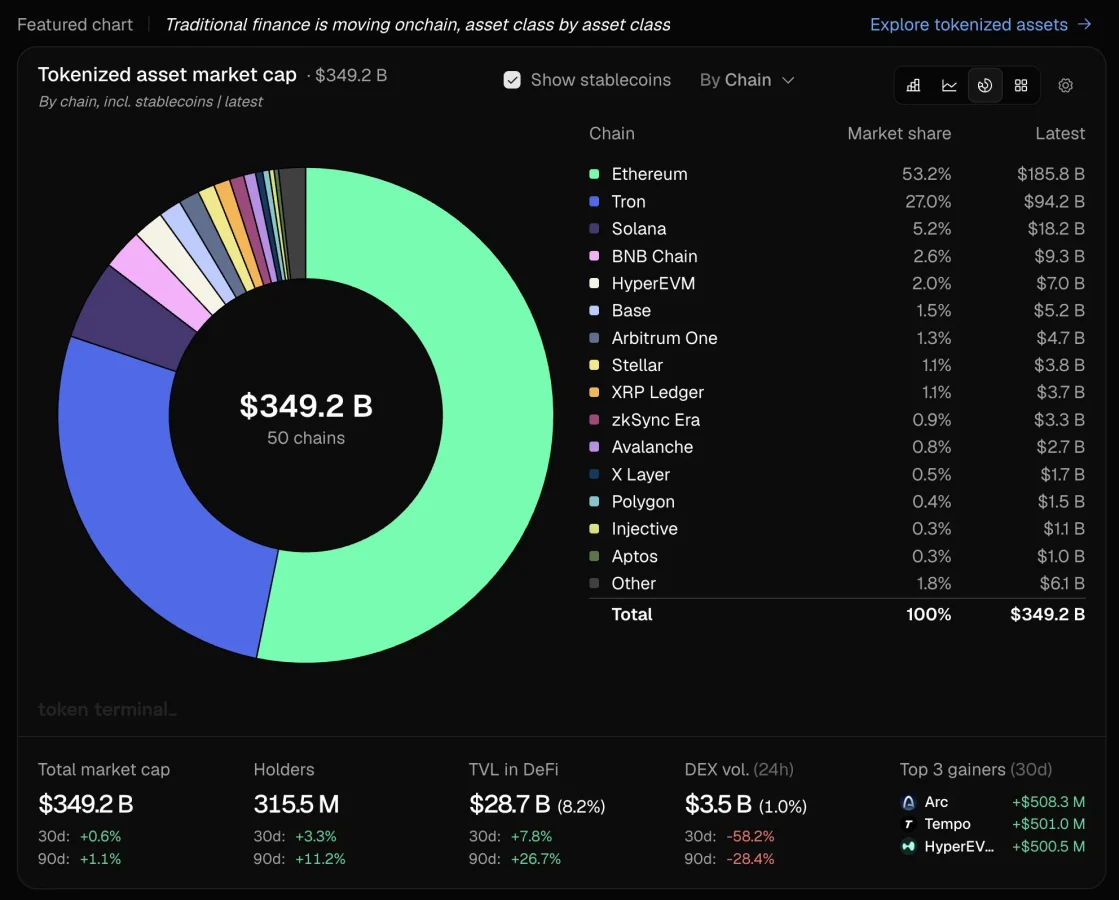
Ethereum has $185.8 billion in RWAs and stablecoins issued on-chain, representing 53.2% of the $349.2 billion market. Meanwhile, newer networks are recording rapid growth, adding another layer to the evolving blockchain competition.
Table of Contents
What Happened With Ethereum?
According to Token Terminal, Ethereum currently leads the market for real-world assets and stablecoins issued on-chain. Its $185.8 billion market share represents more than half of the total tracked market, giving Ethereum a substantial lead over competing blockchain networks in this sector.
Source: Token Terminal’s X Post
The figures come as tokenized assets and stablecoins continue expanding across multiple blockchain ecosystems. Over the past 30 days, Arc added $508.3 million in market cap, while Tempo gained $501 million and HyperEVM increased by $500.5 million. The growth shows that newer networks are attracting significant capital despite Ethereum maintaining the largest share.
Also Read: Ethereum Price: 55% DeFi TVL Powers $32B to 100x RWA Boom
Why Is the Market Watching Ethereum?
Ethereum’s dominance in tokenized assets gives the network an important fundamental backdrop for ETH. Real-world assets and stablecoins are increasingly becoming key components of blockchain-based financial infrastructure, with Ethereum continuing to host a significant portion of this activity.
On the other hand, the fast increase in the market capitalization of Arc, Tempo, and HyperEVM demonstrates the intensifying rivalry. All three networks have gained around half a billion dollars in the last month, indicating that more money and action is being moved into new ecosystems. Thus, keeping the leading role in the market could be vital for Ethereum.
What Does the ETH Price Setup Show?
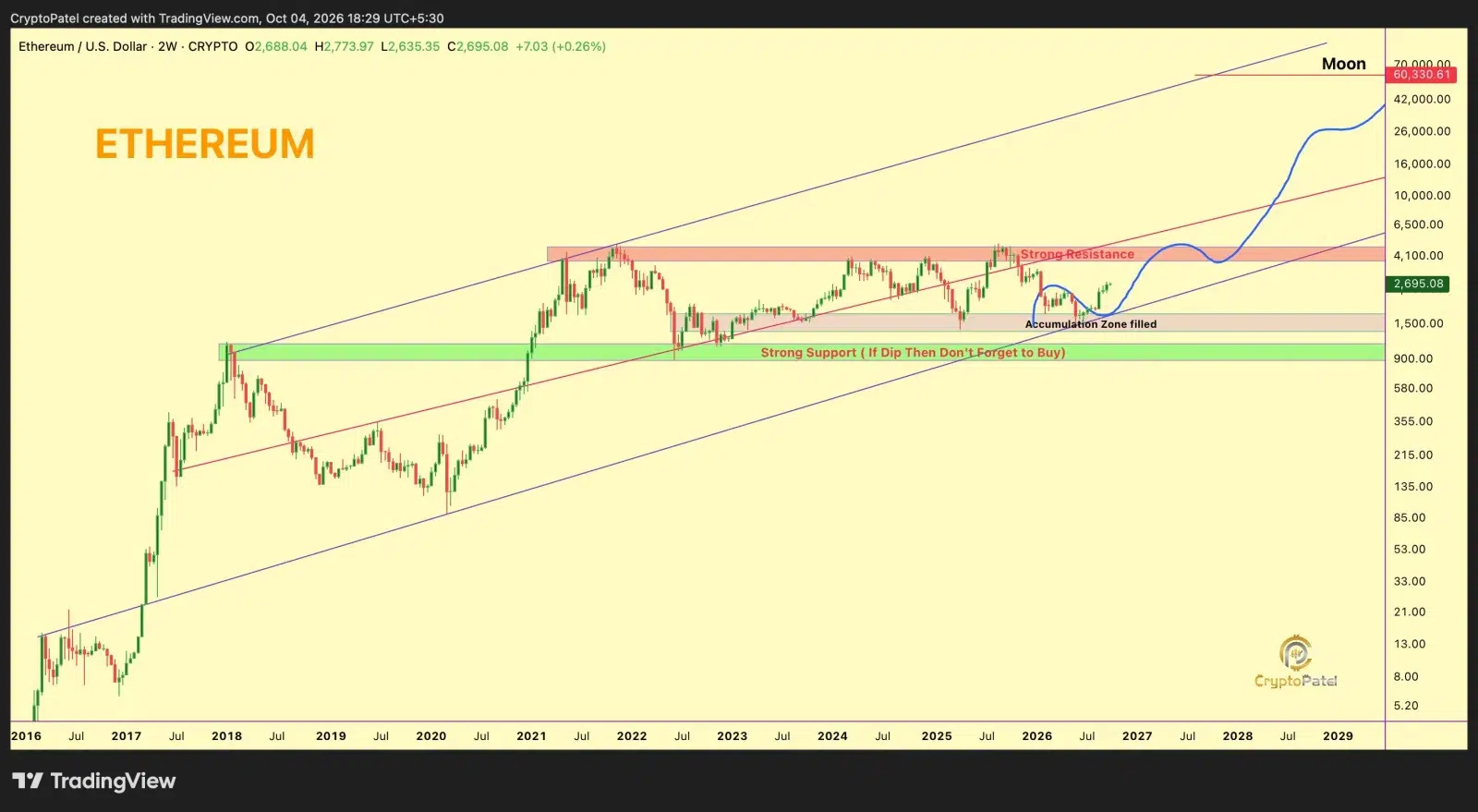
Price structure over the long term for the ETH price is also garnering interest. According to Crypto Patel, there is an ascending channel on the higher time frame chart, which means the ETH price continues to be bullish even during periods of consolidation and accumulation.
The analyst determined that the $900-$1,200 range was a critical support level while the $1,500-$2,000 range was an accumulation area. Going above the existing formation, $4,100 is an essential resistance level on a higher timeframe. Moving above this level would be significant to the analyst’s expansion story.
Source: Crypto Patel’s X Post
Crypto Patel has drawn an ambitious long-term roadmap for the ETH price, with $10,000+ identified as a possible expansion point and $60,000 as the macro bull-case scenario for the analyst.
However, the forecast is contingent upon the ETH price sustaining an upward structure over a long period of time and managing to break through major resistance levels. Consequently, the $60,000 price level needs to be considered in this regard as a possible analyst case. It is still necessary for the ETH price to test its support base before proceeding further.
What Happens Next?
The presence of Ethereum in the markets of RWA and stablecoins will continue being one of the key metrics for measuring the performance, while other competing blockchains keep growing. According to the recent statistics, the tokenization process is no longer limited by one blockchain anymore.
In the case of the ETH price, the main emphasis still stays on the overall technical structure along with the $4,100 level of resistance as pointed out by Crypto Patel. Growth of the ecosystem can help in boosting the fundamentals of Ethereum, whereas any technical support breakage could hurt the overall setup.
Also Read: Ethereum Exit Queue Hits 850K ETH as Validator Demand Rises
This article contains market analysis and price predictions. These are not guarantees. Crypto markets are volatile. Always DYOR. Not financial advice.