Ethereum’s institutional narrative is moving from speed to security and liquidity, a shift that is anchoring long-term Ethereum price strength. SharpLink Gaming CEO Joseph Chalom suggested, on The Rollup, in a clip circulated by ETH Daily on X, that just as capital moves up from millions to billions, institutions don’t listen to basis points; they worry about having a network that can safeguard value, earn the trust of risk committees, and provide deep liquidity.
Chalom, a 20-year BlackRock veteran who helped launch iShares Bitcoin and Ethereum trusts and now heads the second-largest corporate holder of ETH, said that despite Ethereum price volatility, recent negativity ignores the institutional scoreboard and “just plays to the other tribalists in the space.”
It is just noise that doesn’t get any closer to the goalpost and doesn’t focus on where the money is flowing. This came as tokenization, stablecoins, and ETFs are increasingly consolidating under Ethereum.
Table of Contents
Security, Trust & Liquidity as Institutional Scoreboard
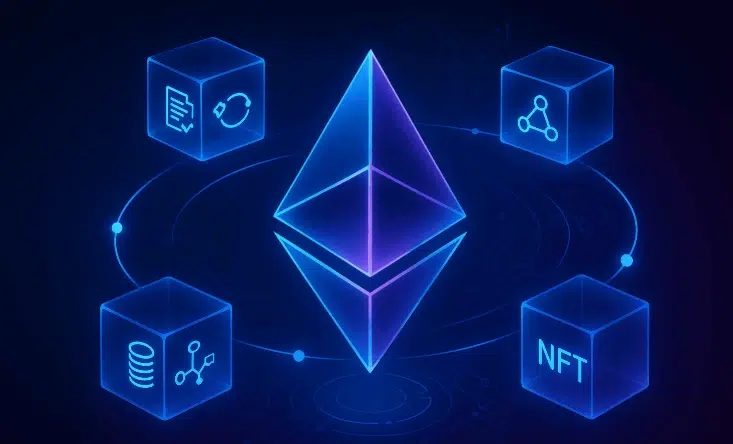
Chalom’s model is based on three primitives that shape Ethereum price resilience. Security represents Ethereum’s continuous operation since 2015, its proof-of-stake security, and its expanding validator set. Trust is the network effect from BlackRock’s BUIDL, Franklin Templeton’s tokenized funds, stablecoin issuers, and spot Ethereum ETFs building on Ethereum. Liquidity is the ability to shift billions without price impact, supplied by stablecoins, DeFi, RWAs, and layer-2s.
Source: YouHodler
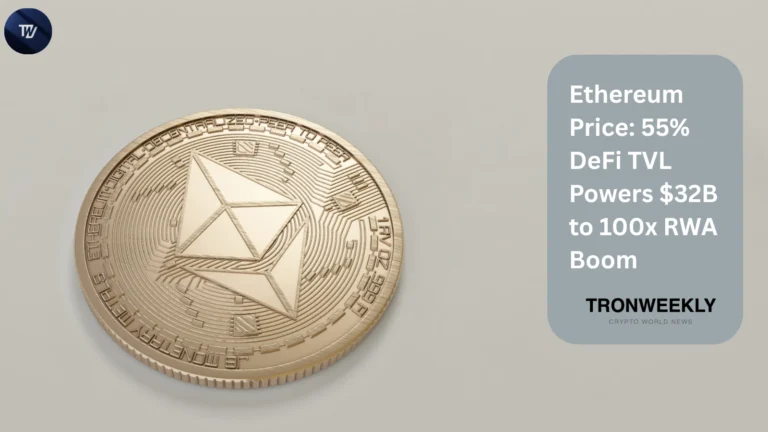
In the clip, Chalom commented that ethereum dominates on all three, noting it settles over 50% of stablecoin volume. DefiLlama ranks ethereum above 55% of DeFi TVL, while RWA. Xyz estimates tokenized real-world assets at roughly $32 billion, subtracting stablecoins, with ethereum and its L2s sourcing the bulk.
For treasuries, that depth diminishes execution risk. SharpLink illustrates the thesis, owning ETH as productive capital, staking it close to its maximum balance, and restaking to earn yield to offset equity dilution.
Also Read: Ethereum Price Eyes Powerful $2.7K Breakout After Fakeout
Ethereum Price Holds Near $2,700 as Institutional Focus Builds
As of October 1, 2026, Ethereum is trading around $2,700, with ETH up roughly 1.4% over the past 24 hours. The token remains below its 52-week high, while recent Ethereum price action has kept ETH near the $2,700 level as investors monitor ETF flows, institutional demand, and Ethereum’s expanding role in tokenized finance.
Ethereum’s price remains closely tied to the broader institutional narrative, with ETF flows, tokenization growth and staking activity emerging as key market signals. Sustained institutional participation could remain an important factor for Ethereum’s price trajectory as Ethereum expands its financial infrastructure role.
The Flywheel and Trust Commodity Thesis
Chalom’s second argument is structural and directly tied to Ethereum price momentum. More capital deepens liquidity, deeper liquidity builds more trust between custodians and regulators, and higher trust attracts more capital. Ethereum’s modular design makes this flywheel more pronounced and effective.

L2s such as Base, Arbitrum, and Optimism lower costs, yet they cooperate with Ethereum because anchoring to the base ultimately provides finality: institutions can connect, but without leaving the bounds of the perimeter of security. These propositions can be equalized with the analogy of the early Amazon, and the forecast for tokenization markets, estimated to multiply 5 to 100 folds their current value, which is estimated to be 32 billion USD, would be Ethereum capturing 50 to 70% of the tokenization market share by 2030.
He contends that Ethereum is the toll road to everything, an element of a future trust commodity that aims to industrialize the destination of the $9.3 trillion allocated by traditional finance annually to clearing and settlement. The full podcast, entitled Joseph Chalom: Ethereum is the toll road to everything, is focused on agentic finance and DeFi within public companies.
If institutions base on security and liquidity, Ethereum proto-drags itself even further along as competing L1s begin consensus superhighway wars on the log-rates. Builders’ log-rates are now optimally deployed across the block builder ecosystem through the EVM 2.0 direction downstream upon demand.
Also Read: Ethereum Price Eyes $2,700 Breakout as ETF Inflows Rise
Risks and Outlook
BitGo, for example, is falling short on our side of around a hundred-million-dollar per quarter return at the tail end of their custody services, staking and tokenized fund services with a select investor base managing long duration holdings.

Regulatory definition of staking, execution risk of upgrades such as PeerDAS, for example, all remain important potential indicators of a need. Next indicators are tangible: tokenized treasury growth, L2 stablecoin metrics, spot Ethereum ETF flows, tracking by SoSoValue, Coinshares, and other institutional investors, and corporate filings.
If tokenization costs as Chalom believes, competition would thereafter be about who is fastest, who has the highest trust score – as the financial infrastructure, settlement layer, and custodian of choice for institutional markets.
Also Read: Ethereum Price Eyes $6,500 as Whale Activity Signals Renewed Interest