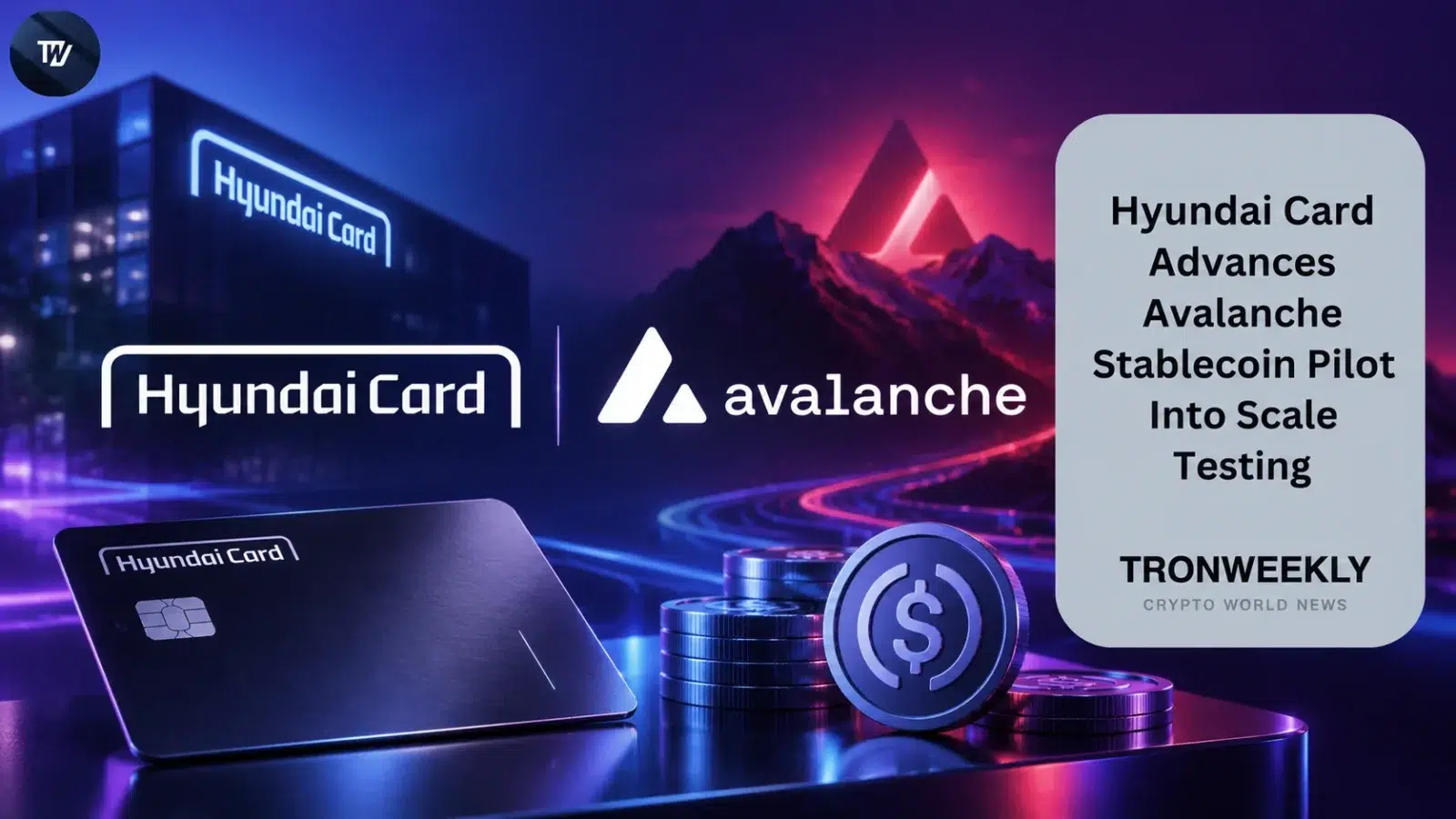
Hyundai Card is moving its Avalanche stablecoin trial to the scale testing phase. A test involving an actual $20,000 transaction connected two Hyundai Motor companies located in the US and Mexico. The test demonstrated that the platform can support corporate settlements.
Table of Contents
Avalanche announced on Sept. 16 that the next step will be scale testing for the model. According to Heejung Nam, who leads payments and business development, a fully operational version of the model must be proven. It says successful scaling is related to the economics of the payment system.
The update does not confirm the release date. It does not also prove approval from Hyundai Motor Group for its normal treasury activities. The latest stage test involves capacity, reliability, and operational requirements.
Also Read: Avalanche Builds on $20M Deposits With Strong Aave RWA Hub
What Hyundai Card Must Prove Next
This first transaction proved that corporate money can be moved within stablecoin infrastructure. However, it did not prove its capacity to manage high-volume transactions or treasury conditions. These issues now become crucial for the next phase of the project.
Hyundai Card has not announced a specific number of transactions it plans to make during the scalability test. It has not revealed either the size of the transaction nor its minimum performance threshold. No criteria have been announced for entering production.
In July, the company said the system had reached a stage where it could be used in practice between overseas Hyundai Motor entities. The announcement said the transaction went beyond a technical demonstration. It involved a real intercompany settlement.
Scaling will entail repeating the same process multiple times within treasury functions. According to the firm, regulation, accounting, tax issues, internal control, and remittance design were all considered before the first remittance. Such considerations still form the cornerstone of future corporate use.
Who Built the Stablecoin Payment Route
Hyundai Motor America supplied the funds used in the first live transaction. It turned $20,000 into USDT and transferred it through the Avalanche network. Afterwards, the USDT was transferred back to US dollars by Hyundai Motor Mexico.
Tether offered a dollar-backed stablecoin as the medium for the transfer. The Avalanche network provided the blockchain layer for the transaction. In addition, the cross-border payment technology of Axiym was used in the pilot program.
According to Hyundai Card, the whole process took seven minutes on average. It included the time for remittance and verification during the pilot test. They compared this with three to four hours or more under the current interbank process.
Where the $20,000 Transfer Moved
The confirmed path for the payment was from Hyundai Motor America to Hyundai Motor Mexico. Company funds would move from the United States to the Mexican company using the stablecoin approach. Dollars were utilized on both sides of the transaction.
This arrangement reduced the foreign exchange dimension of the test. The sending party would convert the dollars into USDT while the receiving party would convert the USDT to dollars. Hence, the test concentrated on remittance efficiency and settlement processes.
The transaction involved actual corporate funds rather than test assets. That linked the pilot directly to a genuine intercompany payment requirement. The company described it as its first cross-border remittance pilot using stablecoin infrastructure.
When the European Test Could Expand Scope
Following the North American transfer, the firm announced its intentions to conduct another test of the platform using Hyundai Motor’s European entities. Circle and Visa would be involved in this stage. The test was also going to incorporate other currencies apart from the US dollar.
The European test was aimed at investigating an aspect that had not been covered in the first transaction. The test would analyze the foreign exchange charges in case both the sender and receiver use different fiat currencies. This could give more insight into the economics of the payment system.
The July plan identified this project as the second proof of concept without mentioning any time frame for the incorporation of this project into the normal activities of the treasury activities.
Public information reviewed as of Sept. 17 does not confirm that the European trial has been completed. Instead, Avalanche’s Sept. 16 update shifted attention back to scalability. The latest public focus therefore remains on scale testing.
Visa has proceeded with the increase in its own stablecoin settlements independently. The company has revealed that there were more than 160 card programs related to stablecoin in the second fiscal quarter of 2026. Visa has added that the annualized stablecoin settlements exceeded $20 billion.
Why Hyundai Card Is Focused on Scale
A successful single transfer does not show whether the system can support routine corporate treasury transactions.
Higher volumes could introduce added operational, accounting, liquidity, and control requirements. The next phase will test whether the infrastructure can perform effectively at a greater scale.
The economic issue is equally important for the next phase of the project. Nam said that the technology should work at scale before its economics could be proven. The quote diverts attention from execution issues to operational efficiency.
Moreover, Hyundai Card did not announce any dates for the commercialization of the technology within Hyundai Motor Group.
Furthermore, in July, the company chose to take a conservative approach towards adoption on a larger scale. It revealed plans to study stablecoins’ usage in cross-border transfers, settlements, and payments infrastructure.
The confirmed developments include the $20,000 US-Mexico transaction, the planned European test, and the recent interest in scaling. All these still fall within the testing phase of the company. No plans for a wider deployment have been made public yet.
Hyundai Card needs to prove that the operating model is able to satisfy other corporate treasury needs. The company has not confirmed regular use of the system for treasury operations.
Also Read: Crypto Tax Bill Wins 38-5 Vote as House Eyes Digital Asset Reform