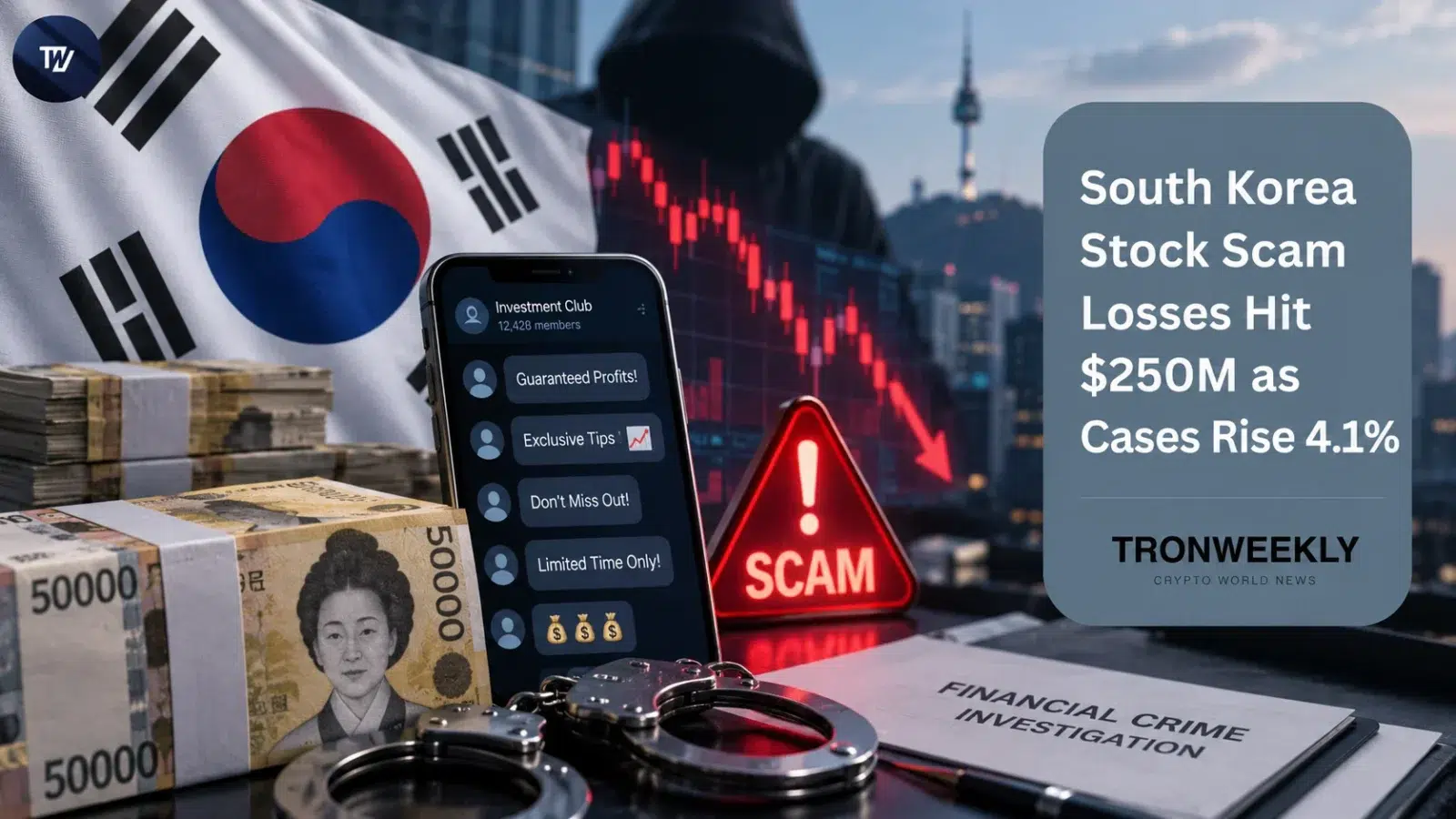
South Korea stock scam losses neared $250 million in the first half of 2026 as fraud linked to stock-tip chatrooms increased. Police investigated 3,506 cases involving 336 billion won. Regulators also widened enforcement efforts.
Table of Contents
Reuters reported on Sept. 16 that the money involved rose 19.8% from the same period in 2025. Investigated cases increased 4.1%. At the reported exchange rate, 336 billion won equaled $246.57 million.
Also Read: Binance System Upgrade Sept 22, 2026 – Safe Powerful Live
What Drove the South Korea Stock Scam Losses Higher?
The rise was made against a backdrop of fluctuating South Korean stocks. As per Reuters, the KOSPI became the best-performing stock index in the world between January and June. It later dropped by up to 44% from its high of June 19.
Financial fraud lawyers told Reuters that fraudsters used market optimism and then confusion to exploit inexperienced investors. The South Korean stock scam normally started with comments under the videos of respected financial analysts or influencers. These led users to private chatrooms for investments.
Some groups charged subscription fees for the advice on stock picking, while others asked for money transfers or fake trading services. The police clarified that the 3,506 figure referred to cases being investigated and not individual victims.
One police case could contain multiple victims. This means that the 3,506 number cannot be taken as the number of people who lost money. The 336 billion won figure referred to money involved in cases during the six-month period.
Who Was Targeted by the Stock-Tip Networks?
One example of such overseas operations was revealed by a Seoul police investigation revealed in June. According to Yonhap, police arrested ten people suspected of stealing 9.9 billion won from 59 South Koreans. The crime occurred between February 2024 and February 2026 in Cambodia.
As revealed by investigators, members acted as employees of securities companies and guided their victims to fake apps. As reported by Edaily, such apps featured fake balance sheets and returns. Furthermore, operators promoted artificial AI-picked stocks and offered up to 600% returns.
The investigation revealed that links to videos created by real financial experts were used to move potential victims into private Naver Band groups. Such fake investors shared stories about their success in such groups.
According to Reuters, a 47-year-old logistics employee joined a Naver group after seeing a video on TikTok. He subsequently sent 60 million won due to the promise of a 600% return. When the group shut down in April, he filed criminal and civil charges.
Where Are Police Expanding Online Enforcement?
The South Korea stock scam investigation takes place in parallel to an ongoing police investigation of Polymarket users.
The South Korean police have charged 26 users with criminal gambling charges amounting to 17.6 billion won, which is approximately $12.7 million. As of Sept. 15, eighteen cases had been referred to the prosecutors.
These figures were reported on Sept. 17 by Asia Business Daily, which cited police documents submitted to lawmaker Yoon Kun-young’s office. Gangwon police logged the largest bet made by an individual at nearly 5.7 billion won. Initial probes took place in March, and official bookings began in May.
Article 246 of South Korea’s Criminal Act, which the police will use for investigations, states that if someone bets digital assets on the outcome of uncertain events and wins or loses money through those actions, it is gambling. Police explained this with an example of a 2008 Supreme Court ruling on chance in gambling.
No indictment, trial date, or court judgment information of the 26 people is mentioned in the police documents released. This is distinct from the Reuters figures on the stock tip fraud that occurred in South Korea.
When Did Regulators Intensify Investor Warnings?
In South Korea, the Financial Services Commission said on September 2 that authorities have started a countrywide fraud prevention campaign. It will continue until the end of 2026. Warnings will be posted on social media, government websites, mobile applications, and billboards.
The FSC mentioned that there were many cases in which illegal entities impersonated investment professionals and made use of content generated by AI technology. It cited the spread of fake news, promises of high returns, and principal protection. Authorities said that some of them collected money from investors and vanished.
The Financial Supervisory Service had issued warnings against illegal stock tip rooms in early 2026 as well. A January warning in which investors were told to be careful if the unknown operator transferred them to private chats. They also mentioned the use of unfamiliar trading software and links to fake investment applications.
On March 23, FSC initiated an investigation and reporting period for financial influencers. The regulator was targeting front running, misleading market information, and fake corporate events.
Why Is the South Korea Stock Scam Drawing Wider Scrutiny?
Police have been working alongside online platforms to combat the South Korean stock scam threat via social media channels. As per the Yonhap report in June, the National Police Agency had shared new strategies with Naver and Kakao. The information is aimed at bolstering their ability to detect such scams.
The second case from Cambodia has highlighted the way in which suspects reportedly assigned roles to one another. According to the Kyunghyang Shinmun report, the members worked as callers, brokerage frauds, translators, and even fake investors.
According to an MBC news report, the police recovered around 273 million won before the indictment of the suspects.
The Financial Supervisory Service confirmed to Reuters that it does not keep a separate database for South Korean stock scam cases.
Investigations into criminal activities belong to law enforcement agencies, according to the regulator. It did not answer whether additional investor-protection rules were being prepared.
Also Read: Circle’s Arc Mainnet Goes Live With 100+ Institutional Partners