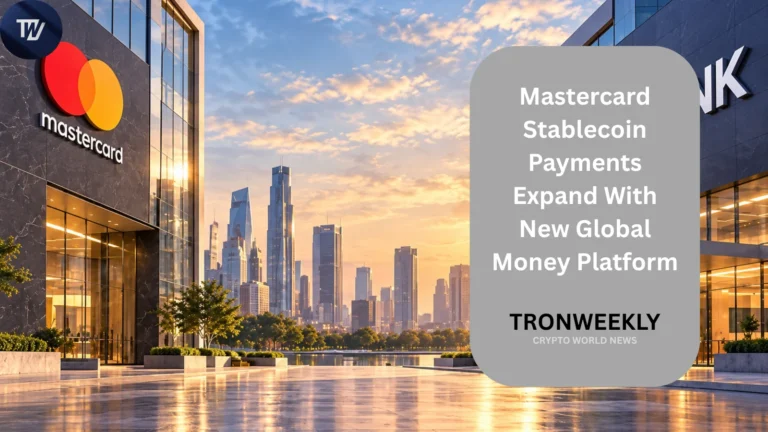
Mastercard stablecoin payments will continue to grow as the firm is rolling out the Global Money Platform, which allows firms to manage traditional currencies and stablecoins by holding, transferring, converting, and spending using one interface.
Table of Contents
With the development, the company comes closer to making digital dollar payments available in its global network while providing banks, fintechs, and enterprises with additional choices when dealing with cross-border transfers.
As stated by the company on Thursday, the solution integrates Mastercard’s payment processing capabilities and the stablecoin platform technology from BVNK, the cryptocurrency payment solutions firm that Mastercard bought in August for about $1.8 billion.
Also Read | Tether Backs AIsa as AI-Driven Payments Gain Momentum Across Digital Finance
How Mastercard Stablecoin Payments Work
This platform is built around a multi-currency account that works with both fiat and stablecoins. Organizations will be able to interchange between these types of currency using just one API.
Mastercard stablecoin payments allows banks, fintech providers, and corporates to incorporate digital assets into their portfolios under their own brands. This solution offers such options as real-time currency exchange, stablecoin-powered cards, direct bank payments, and management of business funds and settlements.
This platform also gives organizations the chance to choose what services they require and scale out in the future. They could begin by accepting and making payments and then add more features such as saving, converting, spending, and managing money.
This setup would make it possible for more firms to launch Mastercard stablecoin payments without having to create their payment systems from scratch.
Mastercard Connects Stablecoins With Global Payments
Global Money Platform connects with Mastercard Move and enables users to make payments using stablecoins, which are then received in local currencies by the receivers using bank accounts.
In 2027, Mastercard plans to enable over 40 currencies in more than 200 countries and territories. Stablecoin balances can be used for spending within the network of merchants, along with card issuance in over 130 countries.
Mastercard stablecoin payments can be utilized by businesses to facilitate international transactions and cross-border payments and funding. The early partners for this service are Nuvei, Marqeta, Ontop, Beem, and Almond FinTech.
Visa Also Expands Stablecoin Payment Services
Mastercard is far from the only payment system incorporating stablecoins into the traditional system of financial operations. Visa recently announced that Inyo Global became the first enabler to integrate the company’s Visa Direct stablecoin prefunding into production for the customers and partners who qualify.

The solution will allow stablecoins to be used for funding payment transactions, which is increasingly popular among users.
The introduction can be regarded as yet another move in the competition between large payment systems trying to find ways of linking blockchain assets and the traditional financial infrastructure.
Mastercard stablecoin payments and the services offered by Visa related to stablecoins are examples of such efforts to provide businesses with flexible funding opportunities.
Still, the solutions serve different purposes, and their future influence will depend on business adoption, demand, and the presence of payment channels.
Mastercard Prepares for AI-Powered Payments
Mastercard is also looking at AI-powered payments where artificial intelligence can purchase things for people and make payments on their behalf according to permission settings.
“Mastercard’s blockchain and digital assets platform is designed to enable programmable payments and the agent economy of the future,” said Raj Dhamodharan, Mastercard’s executive vice president of blockchain and digital assets.
Mastercard has partnered with cryptocurrency firms like Coinbase and Ripple to enable AI-powered payments. The firm already has a New York BitLicense that covers stablecoins and tokenized deposits.
Mastercard plans to incorporate the agent economy and tokenized deposits into its platform, thereby extending Mastercard stablecoin payments to business operations.
What the Launch Means for Stablecoin Adoption
Mastercard is entering the space of existing companies that link digital assets and conventional finance. The platform includes stablecoins, currency exchanges, banking transfers, and card payments to ease the use of digital dollars.
Mastercard stablecoin payments may assist businesses in managing international transactions and settlements and linking recipients to local banks. It could also provide an opportunity for banks to deliver stablecoin products without developing their own platforms.
The success of the product will depend on costs, regulations, the needs of businesses, and the availability of the service. Overall, the Global Money Platform is another move in Mastercard’s digital assets strategy.
Also Read | Arbitrum Launches Stablecoin Growth Program as ARB Price Setup Improves