
Bitcoin linked to the U.S. government moved sharply on October 8, with 12,267.02 BTC worth about $1.01 billion leaving an address labeled as funds seized from the Bitfinex hack. The transaction adds to more than 6,200 BTC previously moved by government-affiliated wallets toward Coinbase Prime over the prior two days. The transfers come as Bitcoin trades under renewed selling pressure and institutional ETF flows weaken.
A $1.01B transfer adds to a growing U.S. government sequence
Arkham Intelligence-tracked on-chain data shows the 12,267.02 BTC transfer occurred on October 8. BlockBeats report reported that about 6,000 BTC was subsequently split across two transactions to a new address, while roughly 6,267 BTC remained at another newly created address. This means the latest $1.01 billion movement did not itself confirm a deposit to an exchange or an executed government sale.
The activity follows separate government-linked transfers totaling about 6,215.7 BTC that moved into Coinbase Prime, according to on-chain data cited by BlockBeats.
Exchange transfers can attract selling concerns because assets become easier to trade, but a transfer to Coinbase Prime does not by itself prove that coins were sold. Coinbase says Prime provides both custody and trading services to institutional clients, making subsequent wallet activity important before drawing a conclusion about market disposal.
Also Read: Bitcoin Transfer Shifts $770M From US Government Wallets to Coinbase Prime
Bitfinex seizure history frames the latest U.S. Bitcoin move
The Bitcoin traces back to the 2016 Bitfinex hack, in which about 119,754 BTC was stolen. The U.S. Department of Justice said it recovered more than 94,000 BTC in 2022 after investigators obtained access to private keys controlling the wallet that held the stolen funds. The recovered coins were valued at more than $3.6 billion at the time of seizure.
The legal status of the seized Bitcoin also matters for interpreting wallet movements. In 2025, the U.S. District Court for the District of Columbia declined to award restitution directly to Bitfinex and said disposition of the forfeited assets would proceed through a third-party forfeiture process because competing ownership claims existed. That means current transfers should not automatically be characterized as a sale or return to Bitfinex without evidence of the next transaction.
U.S. Bitcoin ETF outflows add pressure to government move
The latest movement comes during a softer institutional-flow backdrop. Farside Investors’ Bitcoin ETF data shows U.S. spot Bitcoin ETFs recorded net outflows of $484.9 million on October 7, following an $89.8 million outflow on October 5, partly offset by inflows on October 1, 2 and 6. Across the first five trading days of October, the products recorded a combined net outflow of about $163.3 million.
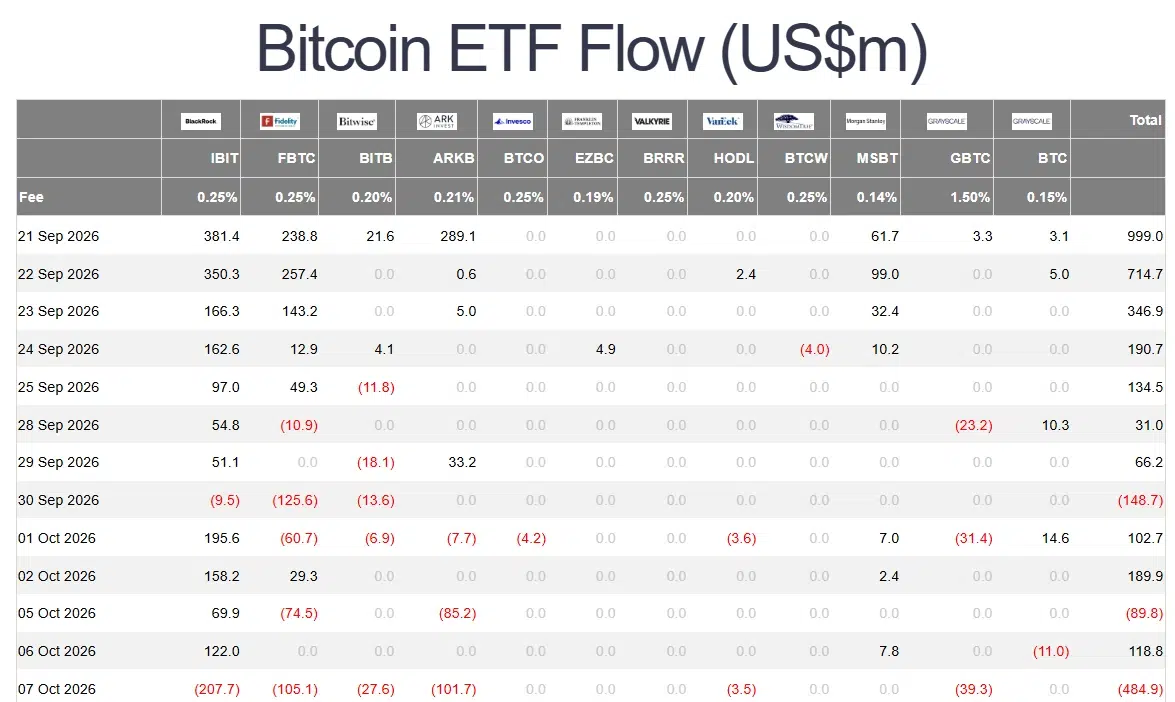
That flow backdrop matters because ETF demand has become a major channel for U.S. institutional exposure to Bitcoin. A sustained reversal would reduce one source of spot-market buying at a time when government-linked wallets are attracting attention for large transfers. However, one week of negative flows is not enough to establish a lasting change in institutional positioning, so subsequent ETF sessions remain important.
Bitcoin tests $81K as U.S. government transfers draw attention
Bitcoin was trading around $82,383 on October 8, down about 0.93% over 24 hours, with a market capitalization near $1.7 trillion and 24-hour volume around $32.5 billion, according to Binance market data.
Glassnode’s latest on-chain research reported that combined Bitcoin spot-exchange and U.S. spot ETF volume averaged about $6.8 billion per day over seven days, describing the level as unusually low. Glassnode also identified a major liquidation cluster around $81,700-$83,300 and large Binance bids near $81,000.
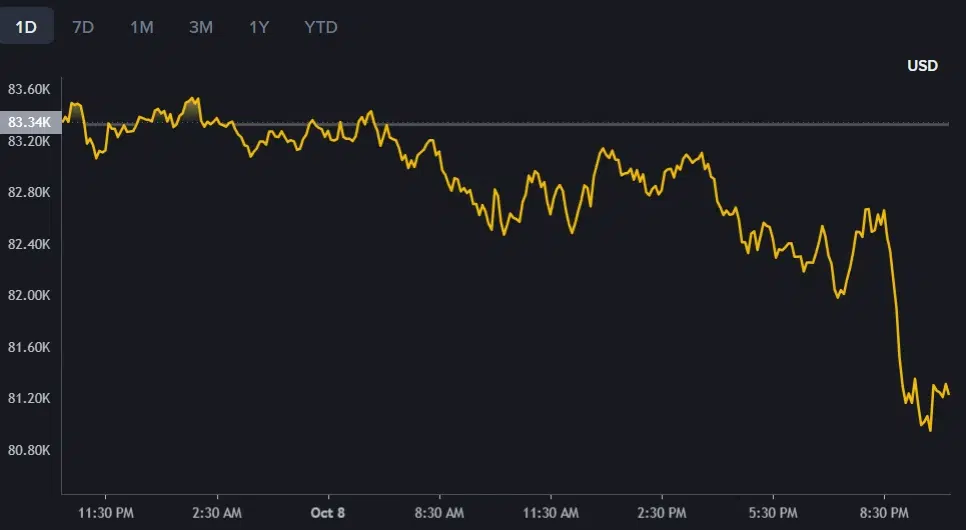
The immediate market impact of the government transfer therefore depends more on whether the coins ultimately reach trading venues than on the headline size alone.
If the newly moved BTC remains in non-exchange wallets, the direct sell-side impact is limited even though the transaction can affect sentiment. Traders will likely watch government-linked addresses, Coinbase Prime flows, ETF flows and the $81,000-$83,000 price zone for confirmation of whether supply pressure is actually increasing.
Also Read: Bitcoin Price Analysis: Ali Charts Spots TD Sequential Buy Signal Near $82K