• Skip to primary navigation
  • Skip to main content
  • Skip to primary sidebar
  • Skip to footer
  • About TronWeekly
  • Write for us
  • Terms and Conditions
  • Privacy Policy
  • Disclaimer
  • Contact
  • All Posts
  • Advertise

TronWeekly

Crypto World News

  • Home
  • Latest News
  • Opinion
    • Education
    • Best TRON Wallets
    • Beginner’s guide to TRON
    • Tron Tokens
    • Market Analysis
  • Industry
    • Tron Exchange
    • Project Review
  • Press Release
  • Bitcoin (BTC)
  • Ripple (XRP)
  • Advertise
  • About TronWeekly
    • The Team
    • Editorial Policy
    • Write for us
    • Privacy Policy
    • Disclaimer
    • Terms and Conditions
    • Contact
You are here: Home / All Posts

All Posts

Hyperliquid Records $4.2M Fees in 24 Hours, Tops Chains

By Amrin Sanjay | Edited By Ammar Raza,June 5, 2026, 8:30 PM

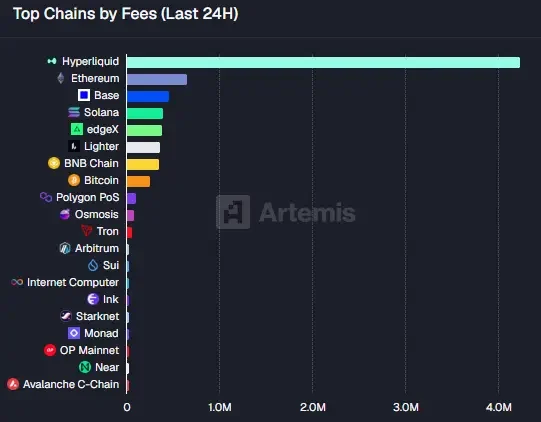
Hyperliquid generated approximately $4.2 million in fees over a 24-hour period, surpassing the combined fee revenue of several major blockchain networks, according to data shared by market observers citing Artemis.

The figure has drawn attention across the cryptocurrency industry, highlighting growing activity on the decentralized trading platform. The reported data showed that HYPE outperformed the combined fee generation of other tracked chains, which totaled around $3.2 million during the same timeframe.

Hyperliquid Leads Daily Fee Rankings

The latest fee rankings place Hyperliquid at the top among major blockchain ecosystems and trading platforms. The network generated roughly $4.2 million in fees within a single day, significantly ahead of competitors listed in the data. Such performance reflects strong trading activity and sustained user engagement on the platform.
Hyperliquid leads daily fee rankings
Source: Artemis

Fee generation is often viewed as an indicator of network usage and economic activity. Higher fees generally suggest that users are actively utilizing a platform’s services. In Hyperliquid’s case, the revenue surge points to continued demand for decentralized perpetual trading and related financial products.

Also Read: HYPE Price Targets $80 as Grayscale Launches Hyperliquid Staking ETF

Trading Activity Drives Revenue Growth

Hyperliquid has emerged as one of the most active decentralized trading venues in the cryptocurrency market. The platform specializes in perpetual futures trading and has attracted users seeking on-chain alternatives to centralized exchanges. Increased trading volumes directly contribute to fee generation, helping explain the strong 24-hour revenue figures.

The platform’s growing popularity has coincided with broader interest in decentralized finance infrastructure. Traders increasingly look for systems that offer transparency, self-custody, and deep liquidity. As activity rises, fee revenue becomes an important metric for evaluating the economic strength of a protocol.

Comparison With Other Blockchain Networks

According to the reported data, Hyperliquid’s $4.2 million in daily fees exceeded the combined $3.2 million generated by other tracked blockchain networks.

Ethereum, Base, Solana, BNB Chain, Bitcoin, and several additional ecosystems appeared on the ranking but generated lower individual fee totals. The comparison highlights the scale of trading activity currently taking place on Hyperliquid.

While blockchain fee rankings can fluctuate significantly from day to day, they provide insight into where users are spending capital and generating economic value.

Networks with higher fee generation often attract attention from investors and analysts. The latest figures suggest Hyperliquid remains a major contributor to on-chain activity.

What the Fee Data Means for the Market

Strong fee generation is frequently interpreted as evidence of real user demand rather than purely speculative interest. Unlike market capitalization figures, fee revenue reflects actual transactions occurring on a network. As a result, analysts often track fees as a measure of protocol health and sustainability.

The latest milestone may strengthen Hyperliquid’s position within the decentralized finance sector. Continued growth in trading volume and revenue could reinforce the platform’s role as a leading on-chain derivatives venue.

However, future rankings will depend on whether current activity levels can be maintained in changing market conditions.

Also Read: Grayscale’s Hyperliquid ETF Nears Launch With 0.29% Fee

Filed Under: Altcoin News, Cryptocurrency News

Solana Coinbase: Forward Industries Powers Bold $31.8M SOL Move

By Ananthyka J | Edited By Ammar Raza,June 5, 2026, 8:00 PM

Solana Coinbase activity is increasing as corporate digital asset strategies expand, with large token transactions highlighting both institutional participation and market risk. Forward Industries just moved 455,800 SOL worth $31.87 million to Coinbase Prime as part of its Solana treasury program.

The program is now reporting unrealized losses of almost $1.13 billion. This piece of news highlights the ways listed companies are dealing with their blockchain-based asset reserves during volatile times.

Institutional Custody Through Coinbase Prime

Forward Industries’ adoption of Coinbase Prime is part of a larger trend where corporations are turning to regulated, institutional-grade custodians for their digital assets.

Solana Coinbase custody through Coinbase Prime is built with compliance in mind and also brings staking services and ways to reach liquidity which treasury managers handling large SOL positions find very attractive. For the company, the decision is to keep most of its Solana assets on a platform that allows for safe settlement and reporting.

Solana Coinbase
Source: Altcoin Buzz

Also Read: Coinbase Loans Surpass $2.3 Billion After Solana Integration Launch

Extent of Solana Treasury Investment

Forward Industries’ Solana treasury program is one of the most public corporate investment programs in $SOL, with Solana Coinbase custody now central to its holdings.

The position that is down unrealized losses of nearly $1.13 billion shows how hard it is to keep a balance between encouraging blockchain adoption eventually and dealing with short-term market cycles.

Forward Industries, down nearly $1.13B on $SOL, deposited 455,784 $SOL($31.87M) to Coinbase Prime after a month of inactivity.

Since launching its Solana treasury strategy in September 2025, Forward Industries has spent ~$1.59B to buy 6.83M $SOL at $232.08.

The 6.83M $SOL… pic.twitter.com/cTZI1mIdCG

— Lookonchain (@lookonchain) June 5, 2026

Corporate treasury strategies which depend on one single digital asset expose companies to concentrated risk, In particular when the value of the networks are highly.

Also Read: Coinbase Integrates DFlow to Improve Solana Trade Execution

Market and Operational Consequences

The Solana Coinbase transfer deposit of 455,800 SOL into Coinbase Prime can enhance operational flexibility, e.g. through staking as well as over-the-counter liquidity options.

Yet, the amount of unrealised losses also points to the need for co-mingling risk management setups for corporate crypto reserves under Solana Coinbase custody. Investors and analysts are keen on such disclosures to see how public companies reconcile their blockchain exposure with their shareholder interests.

This article contains market analysis and price predictions. These are not guarantees. Crypto markets are volatile. Always DYOR. Not financial advice.

Also Read: Coinbase India Launches INR Rails With IMPS Support 2026

Filed Under: Solana (SOL), Cryptocurrency News

2026 Tokenized Bonds Gain Momentum: Hong Kong Expert Group

By Aishwarya shashikumar | Edited By Ammar Raza,June 5, 2026, 7:30 PM

Hong Kong is taking another step toward the future of finance. The Hong Kong Monetary Authority (HKMA) has formed an expert group to support the growth of tokenized bonds.

The initiative brings together leading financial institutions and technology firms as the region pushes deeper into digital asset innovation.

The group includes participants such as JPMorgan Securities, HSBC, Standard Chartered Bank, UBS, Ant Digital, and HashKey Group.

According to the HKMA, members will examine market practices, policy measures, and technological innovations. The goal is to encourage broader adoption and improve the scalability of tokenized bonds.

Also Read: Goldman Sachs Makes Bold Move Into Crypto With Tokenized Bonds and 24/7 Trading

Tokenized Bonds Build on Hong Kong’s Digital Finance Strategy

The latest move follows several years of work in the tokenization sector. In 2021, the HKMA partnered with the Bank for International Settlements to study bond tokenization and its potential benefits.

Hong Kong then moved from research to execution. In February 2023, the government issued HK$800 million worth of tokenized green bonds. A year later, it expanded those efforts with a HK$6 billion multi-currency digital green bond offering. The issuance included Hong Kong dollars, Chinese yuan, U.S. dollars, and euros.

Source: hkma.gov

Last year, Hong Kong also launched what was then the world’s largest digital bond issuance. The offering was notable for integrating both the e-CNY and e-HKD, highlighting the region’s ambitions in digital finance.

Tokenized Bonds Attract Global Attention

The expert group held its first discussions in May. Participants focused on Hong Kong’s legal and regulatory framework and how existing rules apply to the issuance and trading of tokenized bonds.

HashKey Group Chairman and CEO Xiao Feng said that scaling tokenized bonds requires more than technology. He noted that legal frameworks, infrastructure, and industry-wide coordination are equally important.

Hong Kong is not alone in this effort. In the United States, the Depository Trust & Clearing Corporation is testing blockchain-based representations of Treasury securities.

Across Asia, Ripple is working with Kyobo Life Insurance in South Korea on tokenized government bond transactions, while Japan Securities Clearing Corporation is exploring blockchain-based collateral using Japanese government bonds.

As governments and institutions experiment with blockchain, tokenized bonds are emerging as one of the most promising use cases for digital assets.

Also Read: Ripple and Kyobo Life Insurance Launch Korea’s First Tokenized Government Bond Settlement in 2026

Filed Under: Cryptocurrency News, Altcoin News, World

XRP Ledger Privacy Targets Risks Behind 46% Crash

By Aishwarya shashikumar | Edited By Ammar Raza,June 5, 2026, 7:00 PM

The debate around privacy in crypto has taken a dramatic turn with XRPL entering the scene with XRP Ledger privacy. A major flaw discovered in Zcash’s Orchard pool exposed risks that had remained hidden since May 2022.

The revelation sparked panic across the market. Zcash’s native token, ZEC, lost 46% of its value in a single day as investors rushed for the exits.

The sell-off highlighted a long-standing challenge for privacy-focused networks. When transactions are hidden from public view, it can become difficult to verify that the total token supply remains accurate.

Concerns about hidden inflation quickly spread through the market, forcing major holders, including Arthur Hayes, to liquidate their positions. Against this backdrop, the XRP Ledger community has unveiled a new approach.

Also Read: XRP Ledger (XRPL) Powers Korea’s Digital Won 2026 Breakthrough

XRP Ledger Privacy Focuses on Verifiable Confidentiality

XRPL Foundation community lead Vet recently teased amendment XLS-0096, known as Confidential Transfers for Multi-Purpose Tokens (MPTs). The proposal introduces what its creators describe as a shift from blind anonymity to verifiable confidentiality.

if you're in zcash, pivot soon to XRP Ledger privacy.

— Vet (@Vet_X0) June 5, 2026

The design relies on EC-ElGamal homomorphic encryption and zero-knowledge proofs. Transaction amounts and user balances remain hidden from public observers. At the same time, validators can still verify the total amount of tokens in circulation.

This creates a balance between XRP Ledger privacy and transparency. The system ensures that the circulating supply never exceeds the authorized maximum. As a result, the risk of secretly creating additional tokens is effectively removed.

Source: Google

XRP Ledger Privacy Adds Security and Compliance Features

The proposal also addresses future security concerns. Compact sigma protocols and range proofs are designed to strengthen protection against advanced cryptographic attacks, including those powered by artificial intelligence.

Another feature is the split balance model. Wallets contain a spending balance and a separate incoming buffer called Inbox. This structure helps prevent transactions from failing due to outdated zero-knowledge proofs.

For institutions, the amendment includes selective disclosure tools and view keys. These features allow users to share information with regulators when required while maintaining commercial confidentiality.

Initially, XLS-0096 will be deployed for stablecoins and tokenized assets using MPTs. However, the framework could eventually serve as the foundation for bringing advanced confidentiality features to XRP itself, creating a new chapter for XRP Ledger privacy.

Also Read: XRPL Services Flags Issues With Its Escrow Releaser Service 

Filed Under: Cryptocurrency News, Altcoin News, Ripple (XRP), World

Zcash Price Crashes Nearly 40% as Bears Eye $200 and $150 Targets in 2026

By Bena Ilyas | Edited By Ammar Raza,June 5, 2026, 6:30 PM

Zcash (ZEC) price has seen tremendous pressure due to a heavy sell-off within a day, leading to a loss of confidence among investors in the market. At the time of writing, ZEC is trading at $305.39, with its daily trading volume standing at $9.12 billion and market capitalization being $5.27 billion. Over the last 24 hours, there has been a decrease of 39.48%in the Zcash price.

ZEC price chart
Source: CoinMarketCap

Also Read | Ripple RLUSD Drives Multichain Growth via Wormhole in 2026

Zcash Price Breakdown After Key Support Loss

The last action from the Zcash price comes after a fast breakdown that took the cryptocurrency down past several major technical points. The fall came quickly after the close at $319.73, indicating a daily decline above 30%. This is worrying as the market becomes more volatile in the lower areas.

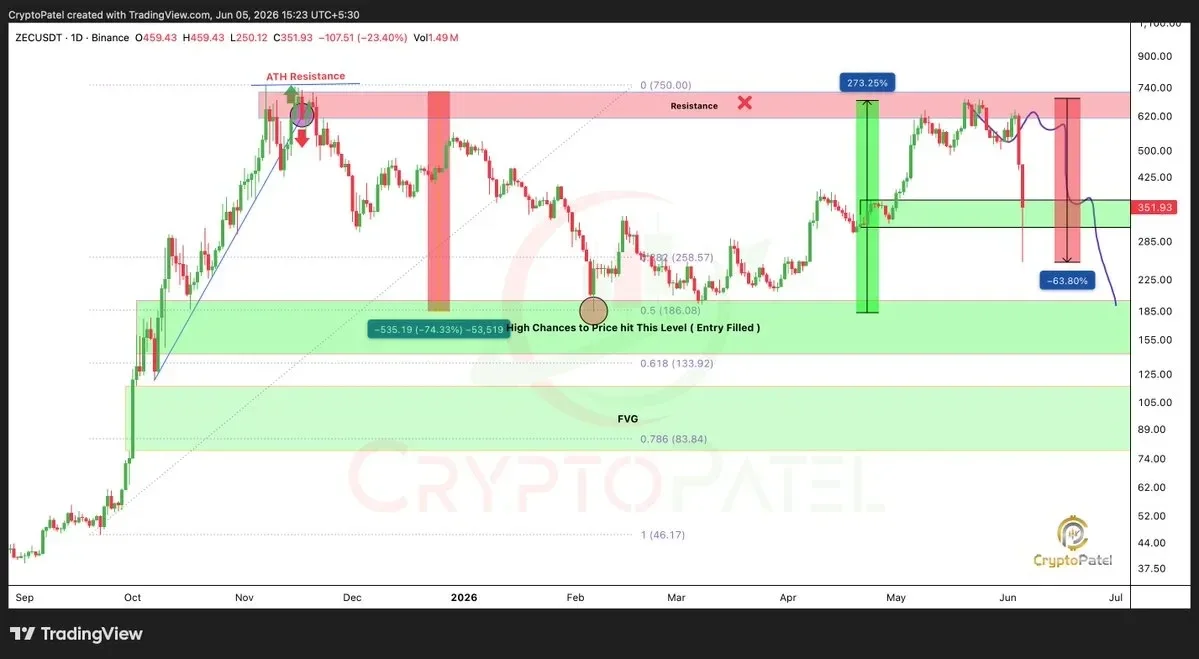
On June 5, 2026, a crypto analyst, Crypto Patel, observed that this fall was expected since he had warned about the high risks involved if the Zcash price ranged from $680 to $750. Based on his forecast, the Zcash price is now down below $350, and at some moments it dropped even lower to $250.

ZEC price chart
Source: Crypto Patel’s X Post

In addition, Patel also identified a recurring pattern involving corrections, with the sharp rises seen in the Zcash price being immediately reversed. According to him, the current correction is reminiscent of a prior one that involved a steep fall in the price of ZEC.

Technical Signals Show Weakening Zcash Price Structure

Technical analysis reveals that the Zcash price is under pressure. The coin dropped below the middle point of the Bollinger Bands at $568.41 and has even gone below the lower bands of the Bollinger Bands at $411.01. It indicates that the sellers have been in control, and the bulls failed to make gains.

The increased distance between the upper and the lower bands indicates growing volatility in the Zcash price, and it is a signal that volatile price movements have become commonplace. Such formations typically form when there is a strong reversal of a trend.

ZEC technical analysis chart
Source: TradingView

Momentum indicators also point to the same conclusion. The MACD line has crossed below the signal line, whereas the histogram is still printing increasingly negative levels. This signals that the momentum of the Zcash price is increasing on the downside, and any reversal could come only with increased buy interest.

Overall, the price of Zcash still experiences strong downward pressure, as technical factors and current events continue to indicate further volatility in the near term.

This article contains market analysis and price predictions. These are not guarantees. Crypto markets are volatile. Always DYOR. Not financial advice.

Also Read | SpaceX IPO Sparks Explosive Retail Investment Boom 2026

Filed Under: Cryptocurrency News, Altcoin News

Ripple-Backed SBI VC Trade to Manage WIZE’s Solana Treasury Operations

By Yahya Raza Sherazi | Edited By Ammar Raza,June 5, 2026, 6:13 PM

Solana treasury activity in Japan gained new support after SBI VC Trade agreed to manage SOL holdings for Tokyo-listed WIZE. The Ripple-backed SBI Holdings subsidiary will oversee trading, custody, storage, and asset management under WIZE’s long-term digital asset strategy framework.

According to SBI VC Trade, the agreement applies to assets of Solana owned via WIZE’s balance-sheet strategy. It will be offered via SBIVC, its platform for corporate and institutional customers. It provides trading services, treasury management, asset management, and Web3 services using cryptocurrencies.

【SBI VCトレード×WIZE】ソラナ取引・保管・運用における連携開始のお知らせ[SBI VCトレード] https://t.co/oWVZCv4h5D

— 北尾吉孝 (@yoshitaka_kitao) June 5, 2026

Also Read: Strategy Leverage Strained as Grayscale Warns of Limited Bitcoin Buying Power

WIZE Moves Solana Treasury Operations to SBI VC Trade

WIZE will use SBIVC for Prime for transaction execution and custody of its SOL holdings. According to the deal, SBI VC Trade will have an operational identity in the company’s Solana treasury plan. It also puts the Japanese crypto company in charge of buying, storing, and running the assets.

In 2025, WIZE established the Solana Treasury Business. The company established SOL as a part of its corporate agenda. It also asserted that digital assets could be used as a supplement to its social entertainment and media business. The new agreement moves the operational part to SBI VC Trade.

SBI VC Trade stated that WIZE chose the firm out of the various firms studied. The review took into account regulatory compliance, security controls, and support for institutional digital asset services. 

The following points were stated in the company’s announcement. The decision connects WIZE’s Solana wallet treasury with a licensed Japanese crypto service provider.

SBI VC Trade has been registered to offer services related to cryptocurrencies in Japan. The company is compliant with the country’s regulations on digital assets. It is also a part of SBI Holdings, which has long been involved in business with Ripple via investment and partnership.

Solana Treasury Demand Grows Among Institutions

The deal for SBI VC Trade represents the first corporate customer for the institutional digital asset business of SBI. According to the company, SBIVC for Prime caters to clients who require trading, custody, treasury, asset management, and Web3 support. The deal also further reinforces its part in treasury services on Solana.

The collaboration is taking place amid growing institutional interest in Solana. Asset management, corporate treasury, and financial institutions have delved into Solana-related products and investment structures. With the WIZE arrangement, a listed Japanese company is added to that activity.

Morgan Stanley recently filed an application for an exchange-traded fund to spot Solana. If passed, the proposed fund will be called MSOL. It would directly hold SOL and pledge part of its assets to earn yield for investors.

If approved by the U.S. Securities and Exchange Commission, the ETF will be listed on NYSE Arca, the filing said. The proposal is in addition to the SBI-WIZE agreement. However, both developments show institutional attention around Solana products and Solana treasury structures.

SBI Holdings has entered the world of AI by partnering with Anthropic. The company said the collaboration will bring Claude AI technology into its wider company operations.

Also Read: Solana Price Faces Pressure Despite 78% Upside Forecast

Filed Under: Cryptocurrency News

JPMorgan, Citi-Backed Tokenized Deposit Network Launch Set for 2027

By Yahya Raza Sherazi | Edited By Ammar Raza,June 5, 2026, 6:03 PM

Major US banks are reportedly preparing a tokenized deposit network for the first half of 2027. The project responds to blockchain firms entering traditional finance. It aims to support faster settlement while keeping deposits inside regulated financial systems and channels.

The Clearing House, a bank-owned payments operator, will run the network. It will connect to traditional payment routes with digital asset infrastructure, Chief Executive Officer David Watson told The Wall Street Journal. The system is designed to accommodate settlement 24 hours a day.

Also Read: Ripple RLUSD Drives Multichain Growth via Wormhole in 2026

Tokenized Deposit Plan Responds to Stablecoin Growth

The Clearing House’s website states that it is co-owned by several large US banks. It is owned by JPMorgan Chase, Bank of America, Citibank, Barclays, BNY, Wells Fargo, and others. The tokenized deposit plan is near the current banking system because of its role.

The tokenized deposit model demonstrates bank response to the growth of stablecoins. Stablecoins have gained attention for faster transfers, programmable movement, and treasury use across blockchain systems. Banks attempt to provide comparable services without moving deposits out of regulated banks.

Source: WSJ

The tokenized deposit initiative also coincides with the legislative push for a US crypto market. Banks have been pushing back on efforts to permit stablecoin issuers to pay yield on user deposits. These products may be in competition with interest-bearing bank deposits.

JPMorgan CEO Jamie Dimon recently criticized the current version of the Digital Asset Market Clarity Act. Cryptocurrency companies seeking to provide yield-bearing services should consider seeking banking licenses. His remarks came after the committee voted in May to move the CLARITY Act forward in the Senate Banking Committee.

The bill is still subject to approval by both houses of Congress before it goes to US President Donald Trump. As digital asset companies grow, the debate has brought the protection of deposits to center stage for banks. The tokenized deposit network falls under that broader response.

Wall Street Tokenization Plans Expand Across Markets

Lydian CEO Carl Grimstad stated that banks are responding to the shift in value. Programmable settlement 24/7 is increasingly important, he said. He additionally said the primary concern is the transfer of value amongst bank ledgers, public chains, and digital assets.

Wall Street companies are also boosting tokenization initiatives in security markets. On March 24, the New York Stock Exchange (NYSE) is collaborating with Securitize to build blockchain trading infrastructure. The plan includes minting tokenized shares of stocks and exchange-traded funds.

On March 18, Nasdaq also got approval from the SEC for a tokenized securities pilot. Earlier in January, Intercontinental Exchange outlined a venue for 24/7 tokenized securities trading. Instant settlement, stablecoin funding, and on-chain settlement were all part of that plan.

South Korea is also piloting the use of tokens for deposits in public finance. On 16 April, its Ministry of Economy and Finance announced the introduction of a pilot for government operational spending. The program will undergo a planned full rollout in the fourth quarter of 2026, following the pilot phase.

Also Read: SpaceX IPO Sparks Explosive Retail Investment Boom 2026

Filed Under: Cryptocurrency News

Grayscale Files New SEC Application for Canton ETF

By Yahya Raza Sherazi | Edited By Messam Raza,June 5, 2026, 5:39 PM

Grayscale Investments moved its Canton ETF plan ahead by filing an application with the U.S. Securities and Exchange Commission for a fund tied to Canton Coin (CC). The proposal would offer exposure to CC. Investors would not need to buy or store the token.

The proposed fund is listed in the filing under the name Grayscale Canton ETF. The fund would mainly hold Canton Coin as its core asset. Its value would be expected to move closely with the market price of CC.

Also Read: Strategy Leverage Strained as Grayscale Warns of Limited Bitcoin Buying Power

Canton ETF Targets Regulated Market Access

The fund model is intended for investors who use traditional stock market platforms. It eliminates the need for crypto exchanges, private wallets, or direct custody. The product has not been launched yet, as the SEC still needs to review the application.

Canton ETF access would expand Grayscale’s list of crypto-linked investment products. The company is also actively filing and updating several ETFs. With its latest use case, it has introduced one more blockchain asset into the regulated fund pipeline.

Canton Coin serves as the native asset of the Canton Network. The network is designed for financial purposes and is geared towards institutional activity. It is designed to bridge the integration between legacy banking and blockchain-based settlement and data solutions.

The design of the Canton Network includes privacy as a key feature. The system enables financial participants to communicate on-chain but keep their information private. This feature is useful for enterprise scenarios where exposing the public data may lead to compliance issues.

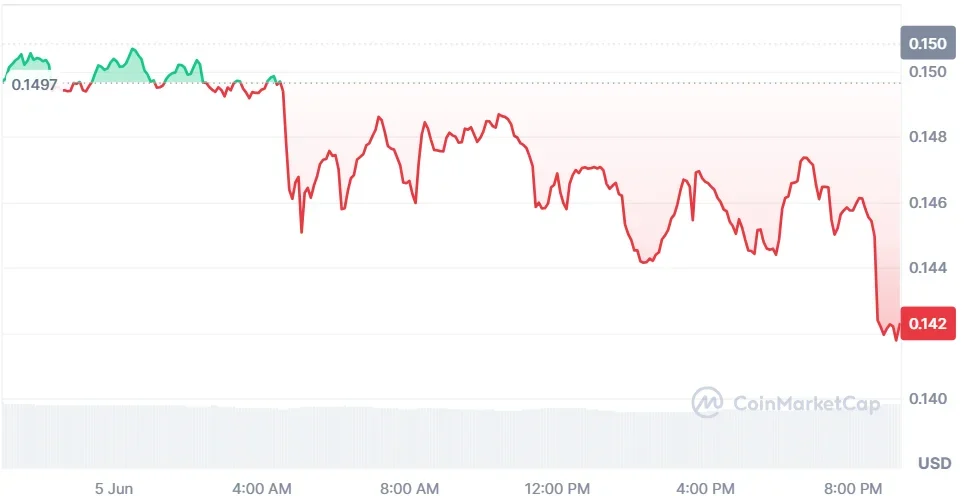
According to CoinMarketCap, Canton Coin (CC) is trading at $0.14 at press time. The token had fallen 5% in the past 24 hours following its high above $0.15 earlier in the day. The trading volume has increased by 0.28% to $27.36 million.

Source: CoinMarketCap

BNB ETF Filing Remains Under SEC Review

The Canton ETF filing comes after Grayscale’s Hyperliquid staking ETF launch on June 3. That product saw almost $5 million in net flow on its first two trading sessions. The launch follows Grayscale’s recent efforts in crypto investment products.

Grayscale has also revised its filing for a spot BNB ETF. The company recently filed an amended S-1 registration statement for a third time. The filing remains pending an SEC response, and the management fee has not been disclosed.

If approved, the BNB ETF is expected to list on the Nasdaq Stock Market. The listing would be subject to rules for commodity-based trust products. Grayscale has also launched offerings related to XRP and Solana staking.

The Canton ETF proposal comes as other asset managers expand crypto fund offerings. Other companies like VanEck are also getting into similar ETF products. If approved, the Canton ETF would provide investors with the opportunity to access Canton Coin without direct token management.

This article contains market analysis and price predictions. These are not guarantees. Crypto markets are volatile. Always DYOR. Not financial advice.

Also Read: SpaceX IPO Sparks Explosive Retail Investment Boom 2026

Filed Under: Cryptocurrency News

South Korean Police Probe Polymarket Users Over Gambling Violations Case

By Tina Fatima | Edited By Ammar Raza,June 5, 2026, 5:30 PM

South Korean police have launched an investigation into local Polymarket users over alleged illegal gambling activities. The probe follows growing regulatory scrutiny of prediction markets linked to real-world events. While facing restrictions in South Korea and Indonesia, Polymarket continues expanding its presence across Asia, including plans for Japan.

South Korean Police Open Investigation Into Polymarket Users

South Korean police have launched an investigation into local users of Polymarket over allegations of illegal gambling.

The probe comes as the cryptocurrency-based prediction market platform faces increasing regulatory attention across Asia.

Authorities are examining whether participation in certain markets offered through the platform may violate the country’s gambling laws.

South Korean Police Probe Polymarket Users
Source: @with_blockmedia

The Gangwon Provincial Police initiated the investigation following a request from the Korean National Police Agency. According to the cyber investigation unit, the focus remains on individuals within South Korea who used the platform.

Officials have not disclosed how many people are currently under investigation as the South Korean Police continue examining the case. Local media outlet Chosun Biz first reported the development.

Also Read: Goldman Sachs, Apex Join Tokenized Real Estate Fund

Election-Related Markets Draw Regulatory Attention

Polymarket allows users to place cryptocurrency-backed predictions on real-world events, including politics, sports, and public affairs. The platform has attracted global attention through markets tied to major political developments and public events.

In May, South Korea’s media regulators reviewed Polymarket’s hosting of illegal gambling-related content. This occurred after contracts related to South Korea’s upcoming local elections on June 3 local elections.

South Korea strictly regulates gambling and only allows a few types of betting through state-sanctioned channels. Activities outside those sanctioned by the government can be investigated by law enforcement.

Moreover, the ongoing investigation by the police and the media regulator adds to the pressure being exerted upon Polymarket and how Polymarket is being evaluated by the Korean government.

Expanding Across Asia Amid Growing Challenges

The regulatory issues Polymarket faces extend far beyond South Korea, as authorities in Indonesia banned it later in May, deeming it a type of internet gambling.

The ban came after there was considerable attention on social media regarding a prediction market about whether or not President Prabowo Subianto would finish his term early.

Despite the challenges, the New York-based company continues to push for growth in Asia. They just appointed a rep in Japan to drive their expansion there. Plus, they’re prepping to apply for permission to launch prediction markets in the country.

While Asian regulators ponder the legality of prediction markets, Polymarket tries to expand but bumps into strict gambling laws and intense oversight.

It’s hard to grow when you’re caught between wanting to innovate and the forces of regulation and national rules.

Also Read: Nvidia Hits $5.4 Trillion Market Cap as Jensen Huang Joins Trump on China Trip

Filed Under: Cryptocurrency News

SOL Price Enters Accumulation Phase After Extended Downtrend, Targets $100

By Tina Fatima | Edited By Ammar Raza,June 5, 2026, 4:30 PM

Solana (SOL) price is shifting into an accumulation phase after a prolonged downtrend, with price stabilizing near key support and volatility compressing. Technical indicators remain weak, showing oversold conditions and bearish MACD momentum. However, improving ecosystem activity and rising liquidity suggest strengthening fundamentals that could support a gradual recovery if buyers sustain control.

SOL Price Structure Shifts Into Accumulation Phase

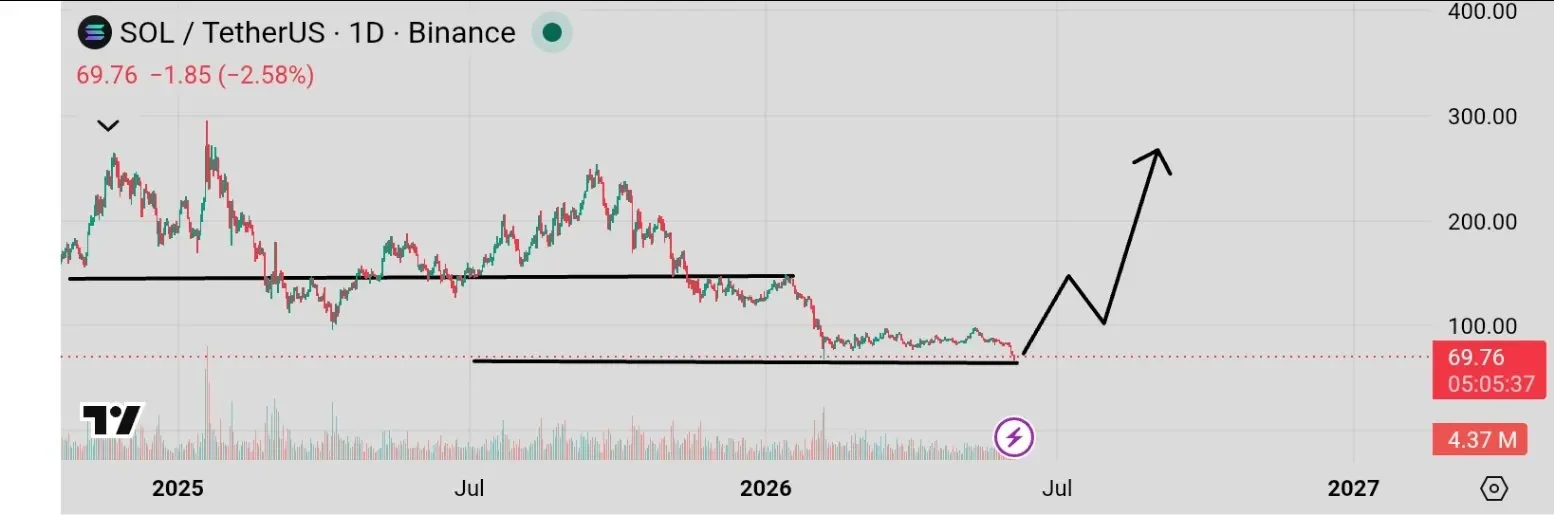
Solana (SOL) 1D chart shows a long-term transition from distribution into accumulation after a prolonged downtrend. SOL Price repeatedly rejected mid-range resistance near $140–$160 before breaking structure downward.

Key demand zone around $70 acts as historical support, where buyers are defending with strong accumulation interest visible, currently forming.

Current price near $65.81 shows consolidation after a prolonged downtrend, with tightening range structure indicating accumulation.

SOL price prediction chart
Source: @hami8040

Selling pressure is fading as volatility compresses and market participants show balance between buyers and sellers. This typically precedes breakout confirmation once resistance levels are reclaimed with strong volume.

The projected scenario outlines a phased recovery beginning with an initial bounce from current support. Followed by a retest phase and potential higher low formation if buyers maintain control above $70.

Upside targets extend toward $100–$120, then $150–$180 and $250+ if the breakout holds firmly, according to the crypto analyst 0xNeena.

Also Read: SOL Price Outlook: Pullback Toward $210 May Precede a Fresh All-Time High

Technical Indicator Points To Downside Risk

However, technical indicators still highlight short-term weakness. The Relative Strength Index (RSI) is now 17.81, which is way below the 30 threshold.

This means that there’s intense selling pressure, but it might be petering out. Also, it’s much lower than its 35.63 moving average, suggesting that market strength is weak and that prices may keep falling soon.

SOL Tradingview chart
Source: TradingView

The MACD remains bearish. The MACD Line sits at -4.35717, below the Signal Line at -2.48208.

With a negative histogram of -1.87509, downward momentum is increasing. Sellers are in charge, although the oversold RSI might suggest a brief rebound soon.

Solana Ecosystem Activity Shows Strong Growth

On the fundamental side, after reaching $68 million USD of revenue generated from the apps using the Solana ecosystem increased 16% over April due to more on-chain activity and better monetization of decentralized applications.

Plus, Collectorcrypt, a marketplace for collectibles and digital gacha games, hit a new high with $9 million in revenue for the month, showing users are more engaged with digital assets.

Tokenized assets hit a new high of $1.1 billion in May, mostly thanks to tokenized equities. Stablecoin supply grew 2% too.

After launching in mid-May, Ethena’s USDe surpassed $500 million, stressing quick DeFi adoption and more cash coming in. This speedy DeFi acceptance and increased funding indicate a positive outlook and possible price gains in the long run.

This article contains market analysis and price predictions. These are not guarantees. Crypto markets are volatile. Always DYOR. Not financial advice.

Also Read: SOL Price Near Key Support as Institutional Adoption of Solana Accelerates

Filed Under: Altcoin News

  • « Go to Previous Page
  • Page 1
  • Interim pages omitted …
  • Page 41
  • Page 42
  • Page 43
  • Page 44
  • Page 45
  • Interim pages omitted …
  • Page 3706
  • Go to Next Page »

Primary Sidebar

Recent Posts

  • TRON Price Consolidates at $0.31–$0.325: Is a Breakout to $0.40 Coming? June 19, 2026
  • HYPE Price Consolidates Near $62 Support as Traders Eye $76 Breakout June 19, 2026
  • Hazel Network Unveiled as Custodia and Vantage Merge Stablecoins With Bank Deposits June 19, 2026
  • ZEC Price Outlook: Can Bulls Reclaim the $500 After Bearish Breakdown? June 19, 2026
  • CFTC and SEC Derivatives Overhaul Begins Amid Growing Perpetual Futures Dispute June 19, 2026

Footer

News

  • Latest News
  • Altcoin News
  • Bitcoin (BTC)
  • Blockchain
  • Tron (TRX)
  • World

Digest

  • Meet the Founder
  • Price Winning Article
  • DeFi
  • Cyber Security
  • Crypto Scam

Industry

  • Project Review
  • Technology
  • Fintech
  • Tron Exchange
  • New in Town

Tron Universe

  • Event and Tron Parties
  • New in Town
  • Tron Tokens

FOLLOW US

  • Facebook
  • Telegram
  • Twitter
  • Linkedin

Subscribe US

Editorial Policy | Privacy Policy | Disclaimer | Terms and Conditions | Masthead

Copyright © 2026 · Tron Weekly. All Rights Reserved. NOTE: Tron Weekly is an independent crypto news site that adheres to the strict journalism policy anchored on transparency, trust, and objectivity, we have no affiliation with the TRON Foundation, its founder Justin Sun or any other cryptocurrency firm.